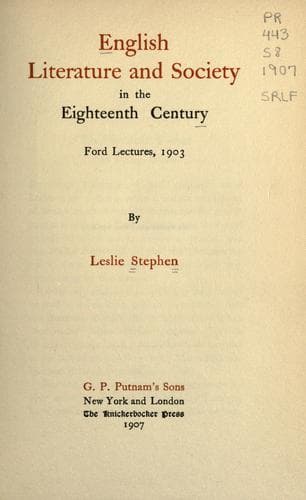
English Literature and Society in the Eighteenth Century — John Shaqi
English Literature and Society in the Eighteenth CenturyStephen, Leslie
History
English Literature and Society in the Eighteenth Century
Stephen, Leslie
England -- Social life and customs -- 18th century; English literature -- 18th century -- History and criticism
power, while the actual monarchy was so far controlled by Parliament
that the Whig had no desire to limit it further. It was a useful
instrument, not an encumbrance.
We have to ask how these conditions affect the literary position. One
point is clear. The relation between the political and the literary
class was at this time closer than it had ever been. The alliance
between them marks, in fact, a most conspicuous characteristic of the
time. It was the one period, as authors repeat with a fond regret, in
which literary merit was recognised by the distributors of state
patronage. This gratifying phenomenon has, I think, been often a little
misinterpreted, and I must consider briefly what it really meant. And
first let us note how exclusively the literary society of the time was
confined to London. The great town--it would be even now a great
town--had half a million inhabitants. Macaulay, in his admirably graphic
description of the England of the preceding period, points out what a
chasm divided it from country districts; what miserable roads had to be
traversed by the nobleman's chariot and four, or by the ponderous
waggons or strings of pack-horses which supplied the wants of trade and
of the humbler traveller; and how the squire only emerged at intervals
to be jeered and jostled as an uncouth rustic in the streets of London.
He was not a great buyer of books. There were, of course, libraries at
Oxford and Cambridge, and here and there in the house of a rich prelate
or of one of the great noblemen who were beginning to form some of the
famous collections; but the squire was more than usually cultivated if
Baker's _Chronicle_ and Gwillim's _Heraldry_ lay on the window-seat of
his parlour, and one has often to wonder how the learned divines of the
period managed to get the books from which they quote so freely in their
discourses. Anyhow the author of the day must have felt that the
circulation of his books must be mainly confined to London, and
certainly in London alone could he meet with anything that could pass
for literary society or an appreciative audience. We have superabundant
descriptions of the audience and its meeting-places. One of the familiar
features of the day, we know, was the number of coffee-houses. In 1657,
we are told, the first coffee-house had been prosecuted as a nuisance.
In 1708 there were three thousand coffee-houses; and each coffee-house
had its habitual circle. There were coffee-houses frequented by
merchants and stock-jobbers carrying on the game which suggested the new
nickname bulls and bears: and coffee-houses where the talk was Whig and
Tory, of the last election and change of ministry: and literary resorts
such as the Grecian, where, as we are told, a fatal duel was provoked by
a dispute over a Greek accent, in which, let us hope, it was the worst
scholar who was killed; and Wills', where Pope as a boy went to look
reverently at Dryden; and Buttons', where, at a later period, Addison
met his little senate.
Public-domain text, read in full here on John Shaqi.
Reviews
Reviews
No reviews yet
Be the first to share your thoughts on this work.
Join the Discussion
Join the discussion
Sign in to leave a comment or review.
Sign InorCreate an account