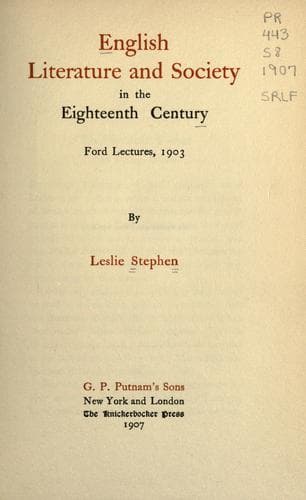
English Literature and Society in the Eighteenth CenturyStephen, Leslie
History
English Literature and Society in the Eighteenth Century
Stephen, Leslie
England -- Social life and customs -- 18th century; English literature -- 18th century -- History and criticism
and patron Halifax was carrying on a tradition. The aristocracy in
Charles's days had been under the impression that poetry, or at least
verse writing, was becoming an accomplishment for a nobleman. Pope's
'mob of gentlemen who wrote with ease,' Rochester and Buckingham, Dorset
and Sedley, and the like, managed some very clever, if not very exalted,
performances and were courted by the men of letters represented by
Butler, Dryden, and Otway. As, indeed, the patrons were themselves
hangers-on of a thoroughly corrupt court, seeking to rise by court
intrigues, their patronage was apt to be degrading and involved the
mean flattery of personal dependence. The change at the Revolution meant
that the court no longer overshadowed society. The court, that is, was
beginning to be superseded by the town. The new race of statesmen were
coming to depend upon parliamentary influence instead of court favour.
They were comparatively, therefore, shining by their own light. They
were able to dispose of public appointments; places on the various
commissions which had been founded as parliament took control of the
financial system--such as commissions for the wine-duties, for licensing
hackney coaches, excise duties, and so forth--besides some of the other
places which had formerly been the perquisites of the courtier. They
could reward personal dependants at the cost of the public; which was
convenient for both parties. Promising university students, like Prior
and Addison, might be brought out under the wing of the statesman, and
no doubt literary merit, especially in conjunction with the right
politics, might recommend them to such men as Halifax or Somers. The
political power of the press was meanwhile rapidly developing. Harley,
Lord Oxford, was one of the first to appreciate its importance. He
employed Defoe and other humble writers who belonged to Grub
Street--that is, to professional journalism in its infancy--as well as
Swift, whose pamphlets struck the heaviest blow at the Whigs in the last
years of that period. Swift's first writings, we may notice, were not a
help but the main hindrance to his preferment. The patronage of
literature was thus in great part political in its character. It
represents the first scheme by which the new class of parliamentary
statesmen recruited their party from the rising talent, or rewarded men
for active or effective service. The speedy decay of the system followed
for obvious reasons. As party government became organised, the patronage
was used in a different spirit. Offices had to be given to gratify
members of parliament and their constituents, not to scholars who could
write odes on victories or epistles to secretaries of state. It was the
machinery for controlling votes. Meanwhile we need only notice that the
patronage of authors did not mean the patronage of learned divines or
historians, but merely the patronage of men who could use their pens in
political warfare, or at most of men who produced the kind of literary
Public-domain text, read in full here on John Shaqi.
Reviews
Reviews
No reviews yet
Be the first to share your thoughts on this work.
Join the Discussion
Join the discussion
Sign in to leave a comment or review.
Sign InorCreate an account