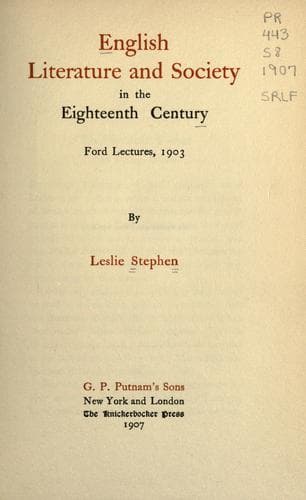
English Literature and Society in the Eighteenth CenturyStephen, Leslie
History
English Literature and Society in the Eighteenth Century
Stephen, Leslie
England -- Social life and customs -- 18th century; English literature -- 18th century -- History and criticism
work appreciated in good society.
The 'town' was the environment of the wits who produced the literature
generally called after Queen Anne. We may call it the literary organ of
the society. It was the society of London, or of the region served by
the new penny-post, which included such remote villages as Paddington
and Brompton. The city was large enough, as Addison observes, to include
numerous 'nations,' each of them meeting at the various coffee-houses.
The clubs at which the politicians and authors met each other
represented the critical tribunals, when no such things as literary
journals existed. It was at these that judgment was passed upon the last
new poem or pamphlet, and the writer sought for their good opinion as he
now desires a favourable review. The tribunal included the rewarders as
well as the judges of merit; and there was plenty of temptation to
stimulate their generosity by flattery. Still the relation means a great
improvement on the preceding state of things. The aristocrat was no
doubt conscious of his inherent dignity, but he was ready on occasion to
hail Swift as 'Jonathan' and, in the case of so highly cultivated a
specimen as Addison, to accept an author's marriage to a countess. The
patrons did not exact the personal subservience of the preceding
period; and there was a real recognition by the more powerful class of
literary merit of a certain order. Such a method, however, had obvious
defects. Men of the world have their characteristic weaknesses; and one,
to go no further, is significant. The Club in England corresponded more
or less to the Salon which at different times had had so great an
influence upon French literature. It differed in the marked absence of
feminine elements. The clubs meant essentially a society of bachelors,
and the conversation, one infers, was not especially suited for ladies.
The Englishman, gentle or simple, enjoyed himself over his pipe and his
bottle and dismissed his womenkind to their bed. The one author of the
time who speaks of the influence of women with really chivalrous
appreciation is the generous Steele, with his famous phrase about Lady
Elizabeth Hastings and a liberal education. The Clubs did not foster the
affectation of Moliere's _Precieuses_; but the general tone had a
coarseness and occasional brutality which shows too clearly that they
did not enter into the full meaning of Steele's most admirable saying.
Public-domain text, read in full here on John Shaqi.
Reviews
Reviews
No reviews yet
Be the first to share your thoughts on this work.
Join the Discussion
Join the discussion
Sign in to leave a comment or review.
Sign InorCreate an account