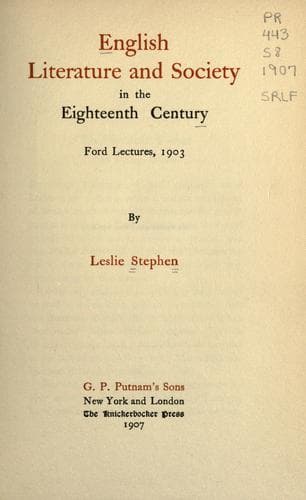
English Literature and Society in the Eighteenth CenturyStephen, Leslie
History
English Literature and Society in the Eighteenth Century
Stephen, Leslie
England -- Social life and customs -- 18th century; English literature -- 18th century -- History and criticism
To appreciate the spirit of this society we must take into account the
political situation and the intellectual implication. The parliamentary
statesman, no longer dependent upon court favour, had a more independent
spirit and personal self-respect. He was fully aware of the fact that he
represented a distinct step in political progress. His class had won a
great struggle against arbitrary power and bigotry. England had become
the land of free speech, of religious toleration, impartial justice, and
constitutional order. It had shown its power by taking its place among
the leading European states. The great monarchy before which the English
court had trembled, and from which even patriots had taken bribes in the
Restoration period, was met face to face in a long and doubtful struggle
and thoroughly humbled in a war, in which an English General, in command
of an English contingent, had won victories unprecedented in our history
since the Middle Ages. Patriotic pride received a stimulus such as that
which followed the defeat of the Armada and preceded the outburst of the
Elizabethan literature. Those successes, too, had been won in the name
of 'liberty'--a vague if magical word which I shall not seek to define
at present. England, so sound Whigs at least sincerely believed, had
become great because it had adopted and carried out the true Whig
principles. The most intelligent Frenchmen of the coming generation
admitted the claim; they looked upon England as the land both of liberty
and philosophy, and tried to adopt for themselves the creed which had
led to such triumphant results. One great name may tell us sufficiently
what the principles were in the eyes of the cultivated classes, who
regarded themselves and their own opinions with that complacency in
which we are happily never deficient. Locke had laid down the
fundamental outlines of the creed, philosophical, religious, and
political, which was to dominate English thought for the next century.
Locke was one of the most honourable, candid, and amiable of men, if
metaphysicians have sometimes wondered at the success of his teaching.
He had not the logical thoroughness and consistency which marks a
Descartes or Spinoza, nor the singular subtlety which distinguishes
Berkeley and Hume; nor the eloquence and imaginative power which gave to
Bacon an authority greater than was due to his scientific requirements.
He was a thoroughly modest, prosaic, tentative, and sometimes clumsy
writer, who raises great questions without solving them or fully seeing
the consequences of his own position. Leaving any explanation of his
power to metaphysicians, I need only note the most conspicuous
condition. Locke ruled the thought of his own and the coming period
because he interpreted so completely the fundamental beliefs which had
been worked out at his time. He ruled, that is, by obeying. Locke
represents the very essence of the common sense of the intelligent
classes.
Public-domain text, read in full here on John Shaqi.
Reviews
Reviews
No reviews yet
Be the first to share your thoughts on this work.
Join the Discussion
Join the discussion
Sign in to leave a comment or review.
Sign InorCreate an account