English Literature and Society in the Eighteenth Century — John Shaqi
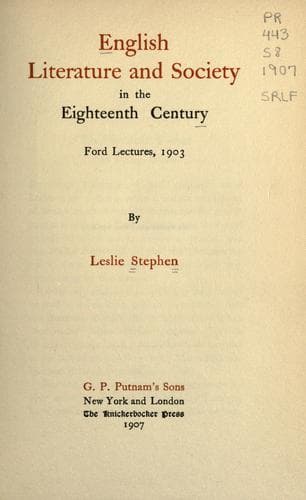
English Literature and Society in the Eighteenth CenturyStephen, Leslie
History
English Literature and Society in the Eighteenth Century
Stephen, Leslie
England -- Social life and customs -- 18th century; English literature -- 18th century -- History and criticism
I may begin by recalling a famous controversy which seems to illustrate
very significantly some of the characteristic tendencies of the day. The
stage, when really flourishing, might be expected to show most
conspicuously the relations between authors and the society. The
dramatist may be writing for all time; but if he is to fill a theatre,
he must clearly adapt himself to the tastes of the living and the
present. During the first half of the period of which I am now speaking,
Dryden was still the dictator of the literary world; and Dryden had
adopted Congreve as his heir, and abandoned to him the province of the
drama--Congreve, though he ceased to write, was recognised during his
life as the great man of letters to whom Addison, Swift, and Pope agreed
in paying respect, and indisputably the leading writer of English
Comedy. When the comic drama was unsparingly denounced by Collier,
Congreve defended himself and his friends. In the judgment of
contemporaries the pedantic parson won a complete triumph over the most
brilliant of wits. Although Congreve's early abandonment of his career
was not caused by Collier's attack alone, it was probably due in part to
the general sentiment to which Collier gave utterance. I will ask what
is implied as a matter of fact in regard to the social and literary
characteristics of the time. The Shakespearian drama had behind it a
general national impulse. With Fletcher, it began to represent a court
already out of harmony with the strongest currents of national feeling.
Dryden, in a familiar passage, gives the reason of the change from his
own point of view. Two plays of Beaumont and Fletcher, he says in an
often quoted passage, were acted (about 1668) for one of Shakespeare or
Jonson. His explanation is remarkable. It was because the later
dramatists 'understood the conversation of gentlemen much better,' whose
wild 'debaucheries and quickness of wit no poet can ever paint as they
have done.' In a later essay he explains that the greater refinement
was due to the influence of the court. Charles II., familiar with the
most brilliant courts of Europe, had roused us from barbarism and
rebellion, and taught us to 'mix our solidity' with 'the air and gaiety
of our neighbours'! I need not cavil at the phrases 'refinement' and
'gentleman.' If those words can be fairly applied to the courtiers whose
'wild debaucheries' disgusted Evelyn and startled even the respectable
Pepys, they may no doubt be applied to the stage and the dramatic
persons. The rake, or 'wild gallant,' had made his first appearance in
Fletcher, and had shown himself more nakedly after the Restoration. This
is the so-called reaction so often set down to the account of the
unlucky Puritans. The degradation, says Macaulay, was the 'effect of the
prevalence of Puritanism under the Commonwealth.' The attempt to make a
'nation of saints' inevitably produced a nation of scoffers. In what
sense, in the first place, was there a 'reaction' at all? The Puritans
Public-domain text, read in full here on John Shaqi.
Reviews
Reviews
No reviews yet
Be the first to share your thoughts on this work.
Join the Discussion
Join the discussion
Sign in to leave a comment or review.
Sign InorCreate an account