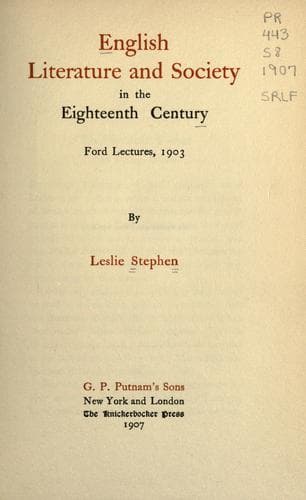
English Literature and Society in the Eighteenth CenturyStephen, Leslie
History
English Literature and Society in the Eighteenth Century
Stephen, Leslie
England -- Social life and customs -- 18th century; English literature -- 18th century -- History and criticism
had suppressed the stage when it was already far gone in decay because
it no longer satisfied the great bulk of the nation. The reaction does
not imply that the drama regained its old position. When the rule of the
saints or pharisees was broken down, the stage did not become again a
national organ. A very small minority of the people can ever have seen a
performance. There were, we must remember, only two theatres under
Charles II., and there was a difficulty in supporting even two. Both
depended almost exclusively on the patronage of the court and the
courtiers. From the theatre, therefore, we can only argue directly to
the small circle of the rowdy debauchees who gathered round the new
king. It certainly may be true, but it was not proved from their
behaviour, that the national morality deteriorated, and in fact I think
nothing is more difficult than to form any trustworthy estimate of the
state of morality in a whole nation, confidently as such estimates are
often put forward. What may be fairly inferred, is that a certain class,
who had got from under the rule of the Puritan, was now free from legal
restraint and took advantage of the odium excited by pharisaical
strictness, to indulge in the greater license which suited the taste of
their patrons. The result is sufficiently shown when we see so great a
man as Dryden pander to the lowest tastes, and guilty of obscenities of
which he was himself ashamed, which would be now inexcusable in the
lowest public haunts. The comedy, as it appears to us, must have been
written by blackguards for blackguards. When Congreve became Dryden's
heir he inherited the established tradition. Under the new order the
'town' had become supreme; and Congreve wrote to meet the taste of the
class which was gaining in self-respect and independence. He tells us in
the dedication of his best play, _The Way of the World_, that his taste
had been refined in the company of the Earl of Montagu. The claim is no
doubt justifiable. So Horace Walpole remarks that Vanbrugh wrote so well
because he was familiar with the conversation of the best circles. The
social influences were favourable to the undeniable literary merits, to
the force and point in which Congreve's dialogue is still superior to
that of any English rival, the vigour of Vanbrugh and the vivacity of
their chief ally, Farquhar. Moreover, although their moral code is
anything but strict, these writers did not descend to some of the depths
often sounded by Dryden and Wycherly. The new spirit might seem to be
passing on with more literary vitality into the old forms. And yet the
consequence, or certainly the sequel to Collier's attack, was the decay
of the stage in every sense, from which there was no recovery till the
time of Goldsmith and Sheridan.
Public-domain text, read in full here on John Shaqi.
Reviews
Reviews
No reviews yet
Be the first to share your thoughts on this work.
Join the Discussion
Join the discussion
Sign in to leave a comment or review.
Sign InorCreate an account