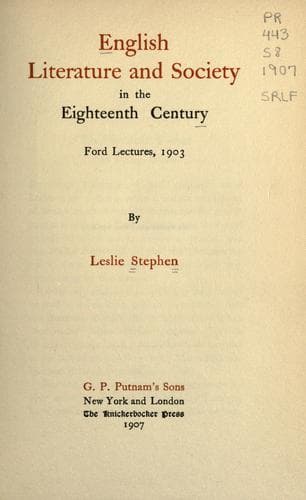
English Literature and Society in the Eighteenth CenturyStephen, Leslie
History
English Literature and Society in the Eighteenth Century
Stephen, Leslie
England -- Social life and customs -- 18th century; English literature -- 18th century -- History and criticism
A recognition of the general principle is implied in the change which
has come over the methods of criticism. It has more and more adopted the
historical attitude. Critics in an earlier day conceived their function
to be judicial. They were administering a fixed code of laws applicable
in all times and places. The true canons for dramatic or epic poetry,
they held, had been laid down once for all by Aristotle or his
commentators; and the duty of the critic was to consider whether the
author had infringed or conformed to the established rules, and to pass
sentence accordingly. I will not say that the modern critic has
abandoned altogether that conception of his duty. He seems to me not
infrequently to place himself on the judgment-seat with a touch of his
old confidence, and to sentence poor authors with sufficient airs of
infallibility. Sometimes, indeed, the reflection that he is representing
not an invariable tradition but the last new aesthetic doctrine, seems
even to give additional keenness to his opinions and to suggest no
doubts of his infallibility. And yet there is a change in his position.
He admits, or at any rate is logically bound to admit, the code which he
administers requires modification in different times and places. The old
critic spoke like the organ of an infallible Church, regarding all forms
of art except his own as simply heretical. The modern critic speaks like
the liberal theologian, who sees in heretical and heathen creeds an
approximation to the truth, and admits that they may have a relative
value, and even be the best fitted for the existing conditions. There
are, undoubtedly, some principles of universal application; and the old
critics often expounded them with admirable common-sense and force. But
like general tenets of morality, they are apt to be commonplaces, whose
specific application requires knowledge of concrete facts. When the
critics assumed that the forms familiar to themselves were the only
possible embodiments of those principles, and condemned all others as
barbarous, they were led to pass judgments, such, for example, as
Voltaire's view of Dante and Shakespeare, which strike us as strangely
crude and unappreciative. The change in this, as in other departments of
thought, means again that criticism, as Professor Courthope has said,
must become thoroughly inductive. We must start from experience. We must
begin by asking impartially what pleased men, and then inquire why it
pleased them. We must not decide dogmatically that it ought to have
pleased or displeased on the simple ground that it is or is not
congenial to ourselves. As historical methods extend, the same change
takes place in regard to political or economical or religious, as well
as in regard to literary investigations. We can then become catholic
enough to appreciate varying forms; and recognise that each has its own
rules, right under certain conditions and appropriate within the given
sphere.
Public-domain text, read in full here on John Shaqi.
Reviews
Reviews
No reviews yet
Be the first to share your thoughts on this work.
Join the Discussion
Join the discussion
Sign in to leave a comment or review.
Sign InorCreate an account