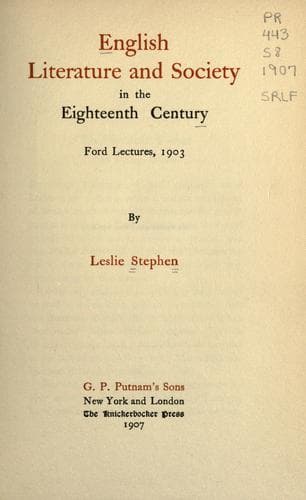
English Literature and Society in the Eighteenth Century — John Shaqi
English Literature and Society in the Eighteenth CenturyStephen, Leslie
History
English Literature and Society in the Eighteenth Century
Stephen, Leslie
England -- Social life and customs -- 18th century; English literature -- 18th century -- History and criticism
The great empire of literature, we may say, has many provinces.
There is a 'law of nature' deducible from universal principles of reason
which is applicable throughout, and enforces what may be called the
cardinal virtues common to all forms of human expression. But
subordinate to this, there is also a municipal law, varying in every
province and determining the particular systems which are applicable to
the different state of things existing in each region.
This method, again, when carried out, implies the necessary connection
between the social and literary departments of history. The adequate
criticism must be rooted in history. In some sense I am ready to admit
that all criticism is a nuisance and a parasitic growth upon literature.
The most fruitful reading is that in which we are submitting to a
teacher and asking no questions as to the secret of his influence.
Bunyan had no knowledge of the 'higher criticism'; he read into the
Bible a great many dogmas which were not there, and accepted rather
questionable historical data. But perhaps he felt some essential
characteristics of the book more thoroughly than far more cultivated
people. No critic can instil into a reader that spontaneous sympathy
with the thoughts and emotions incarnated in the great masterpieces
without which all reading is cold and valueless. In spite of all
differences of dialect and costume, the great men can place themselves
in spiritual contact with men of most distant races and periods. Art, we
are told, is immortal. In other words, is unprogressive. The great
imaginative creations have not been superseded. We go to the last new
authorities for our science and our history, but the essential thoughts
and emotions of human beings were incarnated long ago with unsurpassable
clearness. When FitzGerald published his _Omar Khayyam_, readers were
surprised to find that an ancient Persian had given utterance to
thoughts which we considered to be characteristic of our own day. They
had no call to be surprised. The writer of the Book of Job had long
before given the most forcible expression to thought which still moves
our deepest feelings; and Greek poets had created unsurpassable
utterance for moods common to all men in all ages.
'Still green with bays each ancient altar stands
Above the reach of sacrilegious hands,'
as Pope puts it; and when one remembers how through all the centuries
the masters of thought and expression have appealed to men who knew
nothing of criticism, higher or lower, one is tempted to doubt whether
the critic be not an altogether superfluous phenomenon.
Public-domain text, read in full here on John Shaqi.
Reviews
Reviews
No reviews yet
Be the first to share your thoughts on this work.
Join the Discussion
Join the discussion
Sign in to leave a comment or review.
Sign InorCreate an account