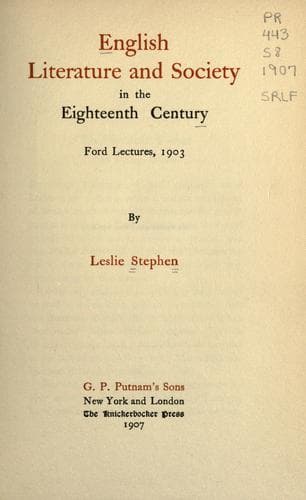
English Literature and Society in the Eighteenth CenturyStephen, Leslie
History
English Literature and Society in the Eighteenth Century
Stephen, Leslie
England -- Social life and customs -- 18th century; English literature -- 18th century -- History and criticism
therefore really good feeling, and to take a true estimate of the real
values of life, a high comedy which can produce irony without
coarseness, expose shams without advocating brutality, becomes for the
first time possible. It must be admitted that the condition is also very
rarely fulfilled.
This, I take it, is the real difficulty. The desirable thing, one may
say, would have been to introduce a more refined and human art and to
get rid of the coarser elements. The excellent Steele tried the
experiment. But he had still to work upon the old lines, which would not
lend themselves to the new purpose. His passages of moral exhortation
would not supply the salt of the old cynical brutalities; they had a
painful tendency to become insipid and sentimental, if not maudlin; and
only illustrated the difficulty of using a literary tradition which
developed spontaneously for one purpose to adapt itself to a wholly
different aim. He produced at best not a new genus but an awkward
hybrid. But behind this was the greater difficulty that a superior
literature would have required a social elaboration, the growth of a
class which could appreciate and present appropriate types. Now even the
good society for which Congreve wrote had its merits, but certainly its
refinement left much to be desired. One condition, as Mr. Meredith again
remarks, of the finer comedy is such an equality of the sexes as may
admit the refining influence of women. The women of the Restoration time
hardly exerted a refining influence. They adopted the ingenious
compromise of going to the play, but going in masks. That is, they
tacitly implied that the brutality was necessary, and they submitted to
what they could not openly approve. Throughout the eighteenth century a
contempt for women was still too characteristic of the aristocratic
character. Nor was there any marked improvement in the tastes of the
playgoing classes. The plays denounced by Collier continued to hold the
stage, though more or less expurgated, throughout the century. Comedy
did not become decent. In 1729 Arthur Bedford carried on Collier's
assault in a 'Remonstrance against the horrid blasphemies and
improprieties which are still used in the English playhouses,' and
collected seven thousand immoral sentiments from the plays (chiefly) of
the last four years. I have not verified his statements. The inference,
however, seems to be clear. Collier's attack could not reform the
stage. The evolution took the form of degeneration. He could, indeed,
give utterance to the disapproval of the stage in general, which we call
Puritanical, though it was by no means confined to Puritans or even to
Protestants. Bossuet could denounce the stage as well as Collier.
Collier was himself a Tory and a High Churchman, as was William Law, of
the _Serious Call_, who also denounced the stage. The sentiment was, in
fact, that of the respectable middle classes in general. The effect was
Public-domain text, read in full here on John Shaqi.
Reviews
Reviews
No reviews yet
Be the first to share your thoughts on this work.
Join the Discussion
Join the discussion
Sign in to leave a comment or review.
Sign InorCreate an account