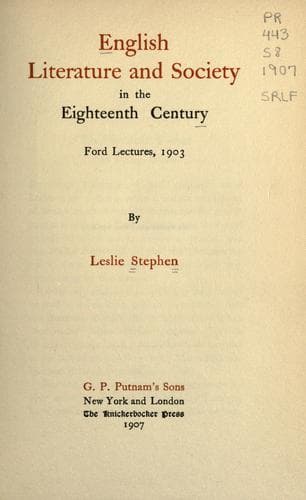
English Literature and Society in the Eighteenth CenturyStephen, Leslie
History
English Literature and Society in the Eighteenth Century
Stephen, Leslie
England -- Social life and customs -- 18th century; English literature -- 18th century -- History and criticism
He dwells upon the seamy side of life,
and if critics, attracted by his undeniable brilliance, have found his
heroines charming, to me it seems that they are the kind of young women
whom, if I adopted his moral code, I should think most desirable
wives--for my friends.
Though realistic in one sense, we may grant to Lamb that such comedy
becomes 'artificial,' and so far Lamb is right, because it supposes a
state of things such as happily was abnormal except in a small circle.
The plots have to be made up of impossible intrigues, and imply a
distorted theory of life. Marriage after all is not really ridiculous,
and to see it continuously from this point of view is to have a false
picture of realities. Life is not made up of dodges worthy of
cardsharpers--and the whole mechanism becomes silly and disgusting. If
comedy is to represent a full and fair portrait of life, the dramatist
ought surely, in spite of Lamb, to find some space for generous and
refined feeling. There, indeed, is a difficulty. The easiest way to be
witty is to be cynical. It is difficult, though desirable, to combine
good feeling with the comic spirit. The humourist has to expose the
contrasts of life, to unmask hypocrisy, and to show selfishness lurking
under multitudinous disguises. That, on Hazlitt's showing, was the
preaching of Wycherly. I can't think that it was the impression made
upon Wycherly's readers. Such comedy may be taken as satire; which was
the excuse that Fielding afterwards made for his own performances. But I
cannot believe that the actual audiences went to see vice exposed, or
used Lamb's ingenious device of disbelieving in the reality. They simply
liked brutal and immoral sentiment, spiced, if possible, with art. We
may inquire whether there may not be a comedy which is enjoyable by the
refined and virtuous, and in which the intrusion of good feeling does
not jar upon us as a discord. An answer may be suggested by pointing to
Moliere, and has been admirably set forth in Mr. George Meredith's essay
on the 'Comic Spirit.' There are, after all, ridiculous things in the
world, even from the refined and virtuous point of view. The saint, it
is true, is apt to lose his temper and become too serious for such a
treatment of life-problems. Still the sane intellect which sees things
as they are can find a sphere within which it is fair and possible to
apply ridicule to affectation and even to vice, and without simply
taking the seat of the scorner or substituting a coarse laugh for a
delicate smile. A hearty laugh, let us hope, is possible even for a
fairly good man. Mr. Meredith's essay indicates the conditions under
which the artist may appeal to such a cultivated and refined humour. The
higher comedy, he says, can only be the fruit of a polished society
which can supply both the model and the audience. Where the art of
social intercourse has been carried to a high pitch, where men have
learned to be at once courteous and incisive, to admire urbanity, and
Public-domain text, read in full here on John Shaqi.
Reviews
Reviews
No reviews yet
Be the first to share your thoughts on this work.
Join the Discussion
Join the discussion
Sign in to leave a comment or review.
Sign InorCreate an account