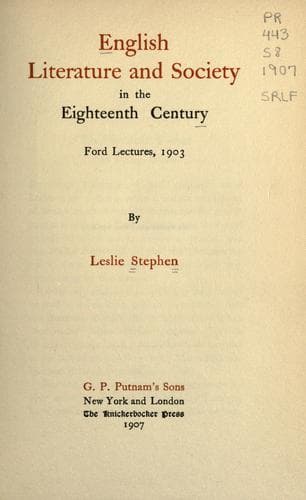
English Literature and Society in the Eighteenth CenturyStephen, Leslie
History
English Literature and Society in the Eighteenth Century
Stephen, Leslie
England -- Social life and customs -- 18th century; English literature -- 18th century -- History and criticism
The Nature thus 'methodised' was the nature of the Wit himself; the set
of instincts and prejudices which to him seemed to be so normal that
they must be natural. Their standards of taste, if artificial to us,
were spontaneous, not fictitious; the Wits were not wearing a mask, but
were exhibiting their genuine selves with perfect simplicity. Now one
characteristic of the Wit is always a fear of ridicule. Above all things
he dreads making a fool of himself. The old lyric, for example, which
came so spontaneously to the Elizabethan poet or dramatist, and of which
echoes are still to be found in the Restoration, has decayed, or rather,
has been transformed. When you have written a genuine bit of
love-poetry, the last place, I take it, in which you think of seeking
the applause of a congenial audience, would be the smoking-room of your
club: but that is the nearest approach to the critical tribunal of Queen
Anne's day. It is necessary to smuggle in poetry and passion in
disguise, and conciliate possible laughter by stating plainly that you
anticipate the ridicule yourself. In other words you write society
verses like Prior, temper sentiment by wit, and if you do not express
vehement passion, turn out elegant verses, salted by an irony which is
a tacit apology perhaps for some genuine feeling. The old pastoral had
become hopelessly absurd because Thyrsis and Lycidas have become
extravagant and 'unnatural.' The form might be adopted for practice in
versification; but when Ambrose Phillips took it a little too seriously,
Pope, whose own performances were not much better, came down on him for
his want of sincerity, and Gay showed what could be still made of the
form by introducing real rustics and turning it into a burlesque. Then,
as Johnson puts it, the 'effect of reality and truth became conspicuous,
even when the intention was to show them grovelling and degraded.' _The
Rape of the Lock_ is the masterpiece, as often noticed, of an
unconscious allegory. The sylph, who was introduced with such curious
felicity, is to be punished if he fails to do his duty, by imprisonment
in a lady's toilet apparatus.
'Gums and pomatums shall his flight restrain,
While clogged he beats his silver wings in vain.'
Public-domain text, read in full here on John Shaqi.
Reviews
Reviews
No reviews yet
Be the first to share your thoughts on this work.
Join the Discussion
Join the discussion
Sign in to leave a comment or review.
Sign InorCreate an account