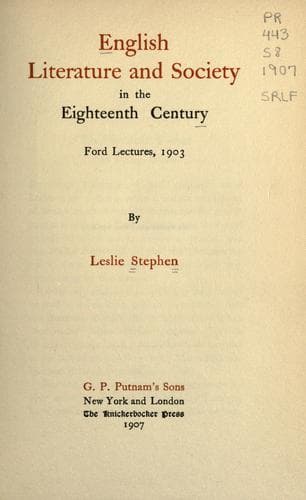
English Literature and Society in the Eighteenth CenturyStephen, Leslie
History
English Literature and Society in the Eighteenth Century
Stephen, Leslie
England -- Social life and customs -- 18th century; English literature -- 18th century -- History and criticism
Delicate fancy and real poetical fancy may be turned to account; but
under the mask of the mock-heroic. We can be poetical still, it seems to
say, only we must never forget that to be poetical in deadly earnest is
to run the risk of being absurd. Even a Wit is pacified when he is thus
dexterously coaxed into poetry disguised as mere playful exaggeration,
and feels quite safe in following the fortune of a game of cards in
place of a sanguinary Homeric battle. Ariel is still alive, but he
adopts the costume of the period to apologise for his eccentricities.
Poetry thus understood may either give a charm to the trivial or fall
into mere burlesque; and though Pope's achievement is an undeniable
triumph, there are blots in an otherwise wonderful performance which
show an uncomfortable concession to the coarser tastes of his audience.
I will not dwell further upon a tolerably obvious theme. I must pass to
the more serious literature. The Wit had not the smallest notion that
his attitude disqualified him for succession in the loftiest poetical
endeavour. He thinks that his critical keenness will enable him to
surpass the old models. He wishes, in the familiar phrase, to be
'correct'; to avoid the gross faults of taste which disfigured the old
Gothic barbarism of his forefathers. That for him is the very meaning of
reason and nature. He will write tragedies which must get rid of the
brutalities, the extravagance, the audacious mixture of farce and
tragedy which was still attractive to the vulgar. He has, indeed, a kind
of lurking regard for the rough vigour of the Shakespearian epoch; his
patriotic prejudices pluck at him at intervals, and suggest that
Marlborough's countrymen ought not quite to accept the yoke of the
French Academy. When Ambrose Phillips produced the _Distrest
Mother_--adapted from Racine--all Addison's little society was
enthusiastic. Steele stated in the Prologue that the play was meant to
combine French correctness with British force, and praised it in the
_Spectator_ because it was 'everywhere Nature.' The town, he pointed
out, would be able to admire the passions 'within the rules of decency,
honour, and good breeding.' The performance was soon followed by _Cato_,
unquestionably, as Johnson still declares, 'the noblest production of
Addison's genius.' It presents at any rate the closest conformity to the
French model; and falls into comic results, as old Dennis pointed out,
from the so-called Unity of Place, and consequent necessity of
transacting all manner of affairs, love-making to Cato's daughter, and
conspiring against Cato himself, in Cato's own hall. Such tragedy,
however, refused to take root. Cato, as I think no one can deny, is a
good specimen of Addison's style, but, except a few proverbial phrases,
it is dead. The obvious cause, no doubt, is that the British public
liked to see battle, murder, and sudden death, and, in spite of
Addison's arguments, enjoyed a mixture of tragic and comic. Shakespeare,
Public-domain text, read in full here on John Shaqi.
Reviews
Reviews
No reviews yet
Be the first to share your thoughts on this work.
Join the Discussion
Join the discussion
Sign in to leave a comment or review.
Sign InorCreate an account