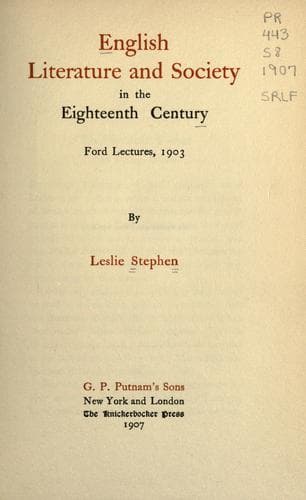
English Literature and Society in the Eighteenth CenturyStephen, Leslie
History
English Literature and Society in the Eighteenth Century
Stephen, Leslie
England -- Social life and customs -- 18th century; English literature -- 18th century -- History and criticism
That was the correct profession of faith. Yet as a good many Wits found
Greek an obstacle, a translation was needed. Chapman had become
barbarous; Hobbes and Ogilvie were hopelessly flat; and Pope was
therefore handsomely paid to produce a book which was to be the standard
of the poetical taste. Pope was thus the chosen representative of the
literary spirit. It is needless to point out that Pope's _Iliad_ is not
Homer's. That was admitted from the first. When we read in a speech of
Agamemnon exhorting the Greeks to abandon the siege,
'Love, duty, safety summon us away;
'Tis Nature's voice, and Nature we obey,'
we hardly require to be told that we are not listening to Homer's
Agamemnon but to an Agamemnon in a full-bottomed wig. Yet Pope's Homer
had a success unparalleled by any other translation of profane poetry;
for the rest of the century it was taken to be a masterpiece; it has
been the book from which Byron and many clever lads first learned to
enjoy what they at least took for Homer; and, as Mrs. Gallup has
discovered, it was used by Bacon at the beginning of the seventeenth
century, and by somebody at the beginning of the twentieth. That it has
very high literary merits can, I think, be denied by no unprejudiced
reader, but I have only to do with one point. Pope had the advantage--I
take it to be an advantage--of having a certain style prescribed for him
by the literary tradition inherited from Dryden. A certain diction and
measure had to be adopted, and the language to be run into an accepted
mould. The mould was no doubt conventional, and corresponded to a
temporary phase of sentiment. Like the costume of the period, it strikes
us now as 'artificial' because it was at the time so natural. It was
worked out by the courtly and aristocratic class, and was fitted to give
a certain dignity and lucidity, and to guard against mere greatness and
triviality of utterance. At any rate it saved Pope from one enormous
difficulty. The modern translator is aware that Homer lived a long time
ago in a very different state of intellectual and social development,
and yet feels bound to reproduce the impressions made upon the ancient
Greek. The translator has to be an accurate scholar and to give the
right shade of meaning for every phrase, while he has also to
approximate to the metrical effect. The conclusion seems to be that the
only language into which Homer could be adequately translated would be
Greek, and that you must then use the words of the original. The actual
result is that the translator is cramped by his fetters; that his use of
archaic words savours of affectation, and that, at best, he has to
emphasise the fact that his sentiments are fictitious. Pope had no
trouble of that kind. He aims at giving something equivalent to Homer,
not Homer himself, and therefore at something really practical. He has
the same advantage as a man who accepts a living style of architecture
Public-domain text, read in full here on John Shaqi.
Reviews
Reviews
No reviews yet
Be the first to share your thoughts on this work.
Join the Discussion
Join the discussion
Sign in to leave a comment or review.
Sign InorCreate an account