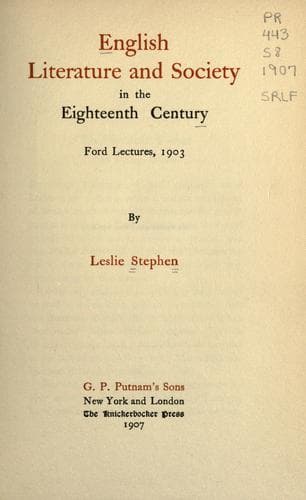
English Literature and Society in the Eighteenth CenturyStephen, Leslie
History
English Literature and Society in the Eighteenth Century
Stephen, Leslie
England -- Social life and customs -- 18th century; English literature -- 18th century -- History and criticism
beliefs and passions affected a man of abnormal genius and marked
idiosyncrasy of character. The historical revelation is the more
complete, precisely because Dante was not a commonplace or average
person but a man of unique force, mental and moral. The remark may
suggest what is the special value of the literary criticism or its
bearing upon history. We may learn from many sources what was the
current mythology of the day; and how ordinary people believed in devils
and in a material hell lying just beneath our feet. The vision probably
strikes us as repulsive and simply preposterous. If we proceed to ask
what it meant and why it had so powerful a hold upon the men of the
day, we may perhaps be innocent enough to apply to the accepted
philosophers, especially to Aquinas, whose thoughts had been so
thoroughly assimilated by the poet. No doubt that may suggest very
interesting inquiries for the metaphysician; but we should find not only
that the philosophy is very tough and very obsolete, and therefore very
wearisome for any but the strongest intellectual appetites, but also
that it does not really answer our question. The philosopher does not
give us the reasons which determine men to believe, but the official
justification of their beliefs which has been elaborated by the most
acute and laborious dialecticians. The inquiry shows how a philosophical
system can be hooked on to an imaginative conception of the universe;
but it does not give the cause of the belief, only the way in which it
can be more or less favourably combined with abstract logical
principles. The great poet unconsciously reveals something more than the
metaphysician. His poetry does not decay with the philosophy which it
took for granted. We do not ask whether his reasoning be sound or false,
but whether the vision be sublime or repulsive. It may be a little of
both; but at any rate it is undeniably fascinating. That, I take it, is
because the imagery which he creates may still be a symbol of thoughts
and emotions which are as interesting now as they were six hundred years
ago. This man of first-rate power shows us, therefore, what was the real
charm of the accepted beliefs for him, and less consciously for others.
He had no doubt that their truth could be proved by syllogising: but
they really laid so powerful a grasp upon him because they could be made
to express the hopes and fears, the loves and hatreds, the moral and
political convictions which were dearest to him. When we see how the
system could be turned to account by the most powerful imagination, we
can understand better what it really meant for the commonplace and
ignorant monks who accepted it as a mere matter of course. We begin to
see what were the great forces really at work below the surface; and the
issues which were being blindly worked out by the dumb agents who were
quite unable to recognise their nature. If, in short, we wish to
discover the secret of the great ecclesiastical and political struggles
Public-domain text, read in full here on John Shaqi.
Reviews
Reviews
No reviews yet
Be the first to share your thoughts on this work.
Join the Discussion
Join the discussion
Sign in to leave a comment or review.
Sign InorCreate an account