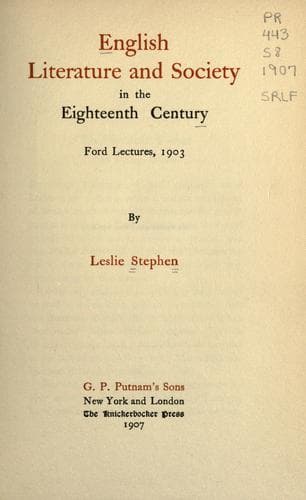
English Literature and Society in the Eighteenth CenturyStephen, Leslie
History
English Literature and Society in the Eighteenth Century
Stephen, Leslie
England -- Social life and customs -- 18th century; English literature -- 18th century -- History and criticism
The critic, however, has become a necessity; and has, I fancy, his
justification in his own sphere. Every great writer may be regarded in
various aspects. He is, of course, an individual, and the critic may
endeavour to give a psychological analysis of him; and to describe his
intellectual and moral constitution and detect the secrets of his
permanent influence without reference to the particular time and place
of his appearance. That is an interesting problem when the materials are
accessible. But every man is also an organ of the society in which he
has been brought up. The material upon which he works is the whole
complex of conceptions, religious, imaginative and ethical, which forms
his mental atmosphere. That suggests problems for the historian of
philosophy. He is also dependent upon what in modern phrase we call his
'environment'--the social structure of which he forms a part, and which
gives a special direction to his passions and aspirations. That suggests
problems for the historian of political and social institutions. Fully
to appreciate any great writer, therefore, it is necessary to
distinguish between the characteristics due to the individual with
certain idiosyncrasies and the characteristics due to his special
modification by the existing stage of social and intellectual
development. In the earliest period the discrimination is impossible.
Nobody, I suppose, not even if he be Provost of Oriel, can tell us much
of the personal characteristics of the author--if there was an
author--of the _Iliad_. He must remain for us a typical Greek of the
heroic age; though even so, the attempt to realise the corresponding
state of society may be of high value to an appreciation of the poetry.
In later times we suffer from the opposite difficulty. Our descendants
will be able to see the general characteristics of the Victorian age
better than we, who unconsciously accept our own peculiarities, like the
air we breathe, as mere matters of course. Meanwhile a Tennyson and a
Browning strike us less as the organs of a society than by the
idiosyncrasies which belong to them as individuals. But in the normal
case, the relation of the two studies is obvious. Dante, for example, is
profoundly interesting to the psychologist, considered simply as a human
being. We are then interested by the astonishing imaginative intensity
and intellectual power and the vivid personality of the man who still
lives for us as he lived in the Italy of six centuries ago. But as all
competent critics tell us, the _Divina Commedia_ also reveals in the
completest way the essential spirit of the Middle Ages. The two studies
reciprocally enlighten each other. We know Dante and understand his
position the more thoroughly as we know better the history of the
political and ecclesiastical struggles in which he took part, and the
philosophical doctrines which he accepted and interpreted; and
conversely, we understand the period the better when we see how its
Public-domain text, read in full here on John Shaqi.
Reviews
Reviews
No reviews yet
Be the first to share your thoughts on this work.
Join the Discussion
Join the discussion
Sign in to leave a comment or review.
Sign InorCreate an account