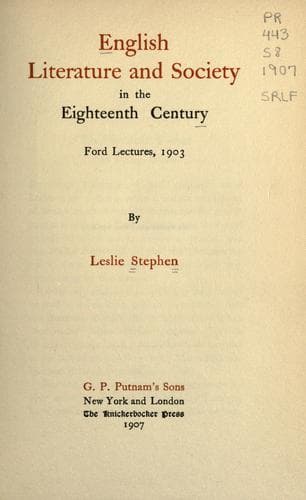
English Literature and Society in the Eighteenth CenturyStephen, Leslie
History
English Literature and Society in the Eighteenth Century
Stephen, Leslie
England -- Social life and customs -- 18th century; English literature -- 18th century -- History and criticism
So much must be said, because the literary work was being more and more
distinctly addressed to the middle class. The literary profession is now
taking more of the modern form. Grub Street is rapidly becoming
respectable, and its denizens--as Beauclerk said of Johnson when he got
his pension--will be able to 'purge and live cleanly like gentlemen.'
Johnson's incomparable letter (1755) rejecting Chesterfield's attempt to
impose his patronage, is the familiar indication of the change. Johnson
had been labouring in the employment of the booksellers, and always,
unlike some more querulous authors, declares that they were fair and
liberal patrons--though it is true that he had to knock down one of them
with a folio. Other writers of less fame can turn an honest penny by
providing popular literature of the heavier kind. There is a demand for
'useful information.' There was John Campbell, for example, the 'richest
author,' said Johnson, who ever grazed 'the common of literature,' who
contributed to the _Modern Universal History_, the _Biographica
Britannica_, and wrote the _Lives of the Admirals_ and the _Political
Survey of Great Britain_, and innumerable historical and statistical
works; and the queer adventurer Sir John Hill, who turned out book after
book with marvellous rapidity and impudence, and is said to have really
had some knowledge of botany. The industrious drudges and clever
charlatans could make a respectable income. Smollett is a superior
example, whose 'literary factory,' as it has been said, 'was in full
swing' at this period, and who, besides his famous novels, was
journalist, historian, and author of all work, and managed to keep
himself afloat, though he also contrived to exceed his income and was
supported by a number of inferior 'myrmidons' who helped to turn out his
hackwork. He describes the author's position in a famous passage in
_Humphry Clinker_ (1756). Smollett also started the _Critical Review_ in
rivalry to the _Monthly Review_, begun by Griffiths a few years before
(1749), and these two were for a long time the only precursors to the
_Edinburgh Review_, and marked an advance upon the old _Gentleman's
Magazine_. In other words, we have the beginning of a new tribunal or
literary Star Chamber. The author has not to inquire what is said of his
performances in the coffee-houses, where the Wits gathered under the
presidency of Addison or Swift. The professional critic has appeared
who will make it his regular business to give an account of all new
books, and though his reviews are still comparatively meagre and apt to
be mere analyses, it is implied that a kind of public opinion is growing
up which will decide upon his merits, and upon which his success or
failure will depend. That means again that the readers to whom he is to
appeal are mainly the middle class, who are not very highly cultivated,
but who have at any rate reached the point of reading their newspaper
Public-domain text, read in full here on John Shaqi.
Reviews
Reviews
No reviews yet
Be the first to share your thoughts on this work.
Elsewhere in the archive
Join the Discussion
Join the discussion
Sign in to leave a comment or review.
Sign InorCreate an account