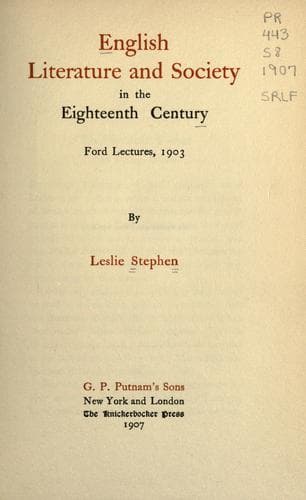
English Literature and Society in the Eighteenth CenturyStephen, Leslie
History
English Literature and Society in the Eighteenth Century
Stephen, Leslie
England -- Social life and customs -- 18th century; English literature -- 18th century -- History and criticism
Another literary movement is beginning which is to lead to the sense of
this deficiency. The nobleman, growing rich and less absorbed in the
political world, has time and leisure to cultivate his tastes, becomes,
as I have said, a dilettante, and sends his son to make the grand tour
as a regular part of his education. Some demon whispers to him, as Pope
puts it, Visto, have a taste! He buys books and pictures, takes to
architecture and landscape-gardening, and becomes a 'collector.' The
instinct of 'collecting' is, I suppose, natural, and its development is
connected with some curious results. One of the favourite objects of
ridicule of the past essayists was the virtuoso. There was something to
them inexpressibly absurd in a passion for buying odds and ends. Pope,
Arbuthnot, and Gay made a special butt of Dr. Woodward, possessor of a
famous ancient shield and other antiquities. Equally absurd, they
thought, was his passion for fossils. He made one of the first
collections of such objects, saw that they really had a scientific
interest, and founded at Cambridge the first professorship of geology.
Another remarkable collector was Sir Hans Sloane, who had brought home a
great number of plants from Jamaica and founded the botanic garden at
Chelsea. His servant, James Salter, set up the famous Don Saltero's
museum in the same place, containing, as Steele tell us, '10,000
gimcracks, including a "petrified crab" from China and Pontius Pilate's
wife's chambermaid's sister's hat.' Don Saltero and his master seemed
equally ridiculous; and Young in his satires calls Sloane 'the foremost
toyman of his time,' and describes him as adoring a pin of Queen
Elizabeth's. Sloane's collections were bought for the nation and became
the foundation of the British Museum; when (1753) Horace Walpole remarks
that they might be worth L80,000 for anybody who loved hippopotamuses,
sharks with one ear, and spiders as big as geese. Scientific research,
that is, revealed itself to contemporaries as a childish and absurd
monomania, unworthy of a man of sense. John Hunter had not yet begun to
form the unequalled museum of physiology, and even the scientific
collectors could have but a dim perception of the importance of a minute
observation of natural phenomena. The contempt for such collections
naturally accompanied a contempt for the antiquary, another variety of
the same species. The study of old documents and ancient buildings
seemed to be a simple eccentricity. Thomas Hearne, the Oxford antiquary,
was a typical case. He devoted himself to the study of old records and
published a series of English Chronicles which were of essential service
to English historians. To his contemporaries this study seemed to be as
worthless as Woodward's study of fossils. Like other monomaniacs he
became crusty and sour for want of sympathy. His like-minded
contemporary, Carte, ruined the prospects of his history by letting out
his belief in the royal power of curing by touch.
Public-domain text, read in full here on John Shaqi.
Reviews
Reviews
No reviews yet
Be the first to share your thoughts on this work.
Elsewhere in the archive
Join the Discussion
Join the discussion
Sign in to leave a comment or review.
Sign InorCreate an account