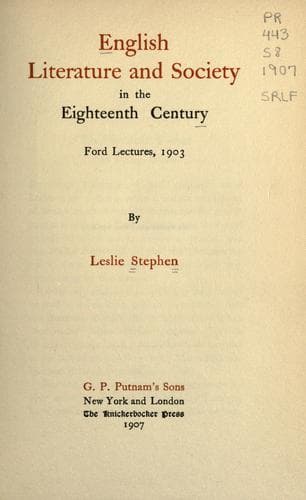
English Literature and Society in the Eighteenth CenturyStephen, Leslie
History
English Literature and Society in the Eighteenth Century
Stephen, Leslie
England -- Social life and customs -- 18th century; English literature -- 18th century -- History and criticism
Antiquarianism, though
providing invaluable material for history, seemed to be a silly
crotchet, and to imply a hatred to sound Whiggism and modern
enlightenment, so long as the Wit and the intelligent person of quality
looked upon the past simply as the period of Gothic barbarism. But an
approximation is beginning to take place. The relation is indicated by
the case of Horace Walpole, a man whose great abilities have been
concealed by his obvious affectations. Two of Walpole's schoolfellows at
Eton were Gray and William Cole. Cole, the Cambridge antiquary, who
tried to do for his own university what Woodward had done for Oxford,
was all but a Catholic, and in political sympathies agreed with Hearne
and Carte. Walpole was a thorough Whig and a freethinker, so long, at
least, as freethinking did not threaten danger to comfortable sinecures
bestowed upon the sons of Whig ministers. But Cole became Walpole's
antiquarian oracle. When Walpole came back from the grand tour, with
nothing particular to do except spend his income, he found one amusement
in dabbling in antiquarian research. He discovered, among other things,
that even a Gothic cathedral could be picturesque, and in 1750 set about
building a 'little Gothic Castle' at Strawberry Hill. The Gothic was of
course the most superficial imitation; but it became the first of a long
line of similar imitations growing gradually more elaborate with results
of which we all have our own opinion. To Walpole himself Strawberry Hill
was a mere plaything, and he would not have wished to be taken too
seriously; as his romance of the _Castle of Otranto_ was a literary
squib at which he laughed himself, though it became the forefather of a
great literary school. The process may be regarded as logical: the
previous generation, rejoicing in its own enlightenment, began to
recognise the difference between present and past more clearly than its
ancestors had done; but generally inferred that the men of old had been
barbarians. The Tory and Jacobite who clings to the past praises its
remains with blind affection, and can see nothing in the present but
corruption and destruction of the foundations of society. The
indifferent dilettante, caring little for any principles and mainly
desirous of amusement, discovers a certain charm in the old institutions
while he professes to despise them in theory. That means one of the
elements of the complex sentiment which we describe as romanticism. The
past is obsolete, but it is pretty enough to be used in making new
playthings. The reconciliation will be reached when the growth of
historical inquiry leads men to feel that past and present are parts of
a continuous series, and to look upon their ancestors neither as simply
ridiculous nor as objects of blind admiration. The historical sense was,
in fact, growing: and Walpole's other friend, Gray, may represent the
literary version. The Queen Anne school, though it despised the older
Public-domain text, read in full here on John Shaqi.
Reviews
Reviews
No reviews yet
Be the first to share your thoughts on this work.
Elsewhere in the archive
Join the Discussion
Join the discussion
Sign in to leave a comment or review.
Sign InorCreate an account