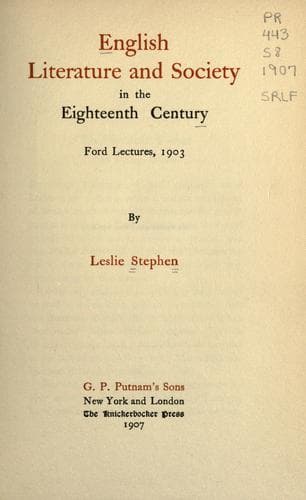
English Literature and Society in the Eighteenth CenturyStephen, Leslie
History
English Literature and Society in the Eighteenth Century
Stephen, Leslie
England -- Social life and customs -- 18th century; English literature -- 18th century -- History and criticism
past experience. The historian began to feel an ambition to deal in
philosophical theories. He was, moreover, touched by the great
scientific movement. A complete survey of the intellectual history of
the time would of course have to deal with the great men who were laying
the foundations of the modern physical sciences; such as Black, and
Priestley, and Cavendish, and Hunter. It would indeed, have to point out
how small was the total amount of such knowledge in comparison with the
vast superstructure which has been erected in the last century. The
foundation of the Royal Institution at the end of the eighteenth century
marks, perhaps, the point at which the importance of physical science
began to impress the popular imagination. But great thinkers had long
recognised the necessity of applying scientific method in the sphere of
social and political investigation. Two men especially illustrate the
tendency and the particular turn which it took in England. Adam Smith's
great book in 1776 applied scientific method to political economy. Smith
is distinguished from his French predecessors by the historical element
of his work; by his careful study, that is, of economic history, and his
consequent presentation of his theory not as a body of absolute and
quasi-mathematical truth, but as resting upon the experience and
applicable to the concrete facts of his time. His limitation is equally
characteristic. He investigated the play of the industrial mechanism
with too little reference to the thorough interdependence of economic
and other social conditions. Showing how that mechanism adapts itself to
supply and demand, he comes to hold that the one thing necessary is to
leave free play to competition, and that the one essential force is the
individual's desire for his own material interests. He became,
therefore, the prophet of letting things alone. That doctrine--whatever
its merits or defects--implies acquiescence in the existing order, and
is radically opposed to a demand for a reconstruction of society. This
is most clearly illustrated by the other thinker Jeremy Bentham.
Bentham, unlike Smith, shared the contempt for history of the absolute
theorists, and was laying down a theory conceived in the spirit of
absolutism which became the creed of the uncompromising political
radicals of the next generation. But it is characteristic that Bentham
was not, during the eighteenth century, a Radical at all. He altogether
repudiated and vigorously denounced the 'Rights of Men' doctrines of
Rousseau and his followers, and regarded the Declaration of
Independence in which they were embodied as a mere hotchpotch of
absurdity. He is determined to be thoroughly empirical--to take men as
he found them. But his utilitarianism supposed that men's views of
happiness and utility were uniform and clear, and that all that was
wanted was to show them the means by which their ends could be reached.
Then, he thought, rulers and subjects would be equally ready to apply
Public-domain text, read in full here on John Shaqi.
Reviews
Reviews
No reviews yet
Be the first to share your thoughts on this work.
Elsewhere in the archive
Join the Discussion
Join the discussion
Sign in to leave a comment or review.
Sign InorCreate an account