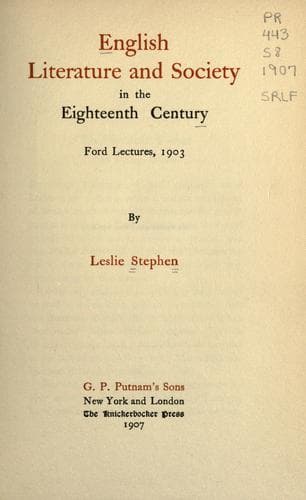
English Literature and Society in the Eighteenth CenturyStephen, Leslie
History
English Literature and Society in the Eighteenth Century
Stephen, Leslie
England -- Social life and customs -- 18th century; English literature -- 18th century -- History and criticism
his principles. He fully accepted Adam Smith's theory of
non-interference in economical matters; and his view of philosophy in
the lump was that there was no such thing, only a heap of obsolete
fallacies and superstitions which would be easily dispersed by the
application of a little downright common sense. Bentham's
utilitarianism, again, is congenial to the whole intellectual movement.
His ethical theory was substantially identical with that of Paley--the
most conspicuous writer upon theology of the generation,--and Paley is
as thoroughly empirical in his theology as in his ethics, and makes the
truth of religion essentially a question of historical and scientific
evidence.
It follows that neither in practice nor in speculative questions were
the English thinkers of the time prescient of any coming revolution.
They denounced abuses, but they had regarded abuses as removable
excrescences on a satisfactory system. They were content to appeal to
common sense, and to leave philosophers to wrangle over ultimate
results. They might be, and in fact were, stirring questions which would
lead to far more vital disputes; but for the present they were
unconscious of the future, and content to keep the old machinery going
though desiring to improve its efficiency. The characteristic might be
elucidated by comparison with the other great European literatures. In
France, Voltaire had begun about 1762 his crusade against orthodoxy, or,
as he calls it, his attempt to crush the infamous. He was supported by
his allies, the Encyclopaedists. While Helvetius and Holbach were
expounding materialism and atheism, Rousseau had enunciated the
political doctrines which were to be applied to the Revolution, and
elsewhere had uttered that sentimental deism which was to be so dear to
many of his readers. Our neighbours, in short, after their
characteristic fashion, were pushing logic to its consequences, and
fully awake to the approach of an impending catastrophe. In Germany the
movement took the philosophical and literary shape. Lessing's critical
writings had heralded the change. Goethe, after giving utterance to
passing phases of thought, was rising to become the embodiment of a new
ideal of intellectual culture. Schiller passed through the storm and
stress period and developed into the greatest national dramatist. Kant
had awakened from his dogmatic theory, and the publication of the
_Critique of Pure Reason_ in 1781 had awakened the philosophical world
of Germany. In both countries the study of earlier English literature,
of the English deists and freethinkers, of Shakespeare and of
Richardson, had had great influence, and had been the occasion of new
developments. But it seemed as though England had ceased to be the
originator of ideas, and was for the immediate future at least to
receive political and philosophical impulses from France and Germany. To
explain the course taken in the different societies, to ask how far it
Public-domain text, read in full here on John Shaqi.
Reviews
Reviews
No reviews yet
Be the first to share your thoughts on this work.
Elsewhere in the archive
Join the Discussion
Join the discussion
Sign in to leave a comment or review.
Sign InorCreate an account