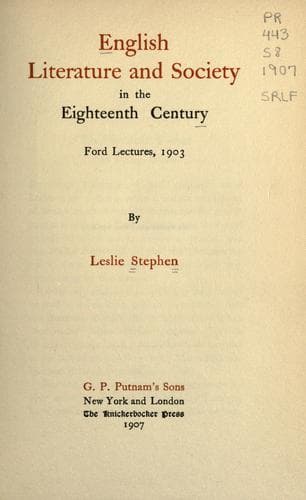
English Literature and Society in the Eighteenth CenturyStephen, Leslie
History
English Literature and Society in the Eighteenth Century
Stephen, Leslie
England -- Social life and customs -- 18th century; English literature -- 18th century -- History and criticism
might be due to difference of characteristics, and of political
constitutions, of social organism and individual genius, would be a very
pretty but rather large problem. I refer to it simply to illustrate the
facts, to emphasise the quiet, orderly, if you will, sleepy movement of
English thought which, though combined with great practical energy and
vigorous investigation of the neighbouring departments of inquiry,
admitted of comparative indifference to the deeper issues involved. It
did not generate that stimulus to literary activity due to the dawning
of new ideas and the opening of wide vistas of speculation. When the
French Revolution broke out, it took Englishmen, one may say, by
surprise, and except by a few keen observers or rare disciples of
Rousseau, was as unexpected as the earthquake of Lisbon.
Let us glance, now, at the class which was to carry on the literary
tradition. It is known to us best through Boswell, and its
characteristics are represented by Johnson's favourite club. In one of
his talks with Boswell the great man amused himself by showing how the
club might form itself into a university. Every branch of knowledge and
thought might, he thought, be represented, though it must be admitted
that some of the professors suggested were scarcely up to the mark. The
social variety is equally remarkable. Among the thirty or forty members
elected before Johnson's death, there were the lights of literature;
Johnson himself and Goldsmith, Adam Smith and Gibbon, and others of
less fame. The aristocratic element was represented by Beauclerk and by
half a dozen peers, such as the amiable Lord Charlemont; Burke, Fox,
Sheridan, and Wyndham represent political as well as literary eminence;
three or four bishops represent Church authority; legal luminaries
included Dunning, William Scott (the famous Lord Stowell), Sir Robert
Chambers, and the amazingly versatile Sir William Jones. Boswell and
Langton are also cultivated country gentlemen; Sir Joseph Banks stood
for science, and three other names show the growing respect for art. The
amiable Dr. Burney was a musician who had raised the standard of his
calling; Garrick had still more conspicuously gained social respect for
the profession of actor; and Sir Joshua Reynolds was the representative
of the English school of painters, whose works still impress upon us the
beauty of our great-grandmothers and the charm of their children, and
suggest the existence of a really dignified and pure domestic life in a
class too often remembered by the reckless gambling and loose morality
of the gilded youth of the day. To complete the picture of the world in
which Johnson was at home we should have to add from the outer sphere
such types as Thrale, the prosperous brewer, and the lively Mrs. Thrale
and Mrs. Montague, who kept a salon and was president of the 'Blues.'
The feminine society which was beginning to write our novels was
represented by Miss Burney and Hannah More; and the thriving booksellers
Public-domain text, read in full here on John Shaqi.
Reviews
Reviews
No reviews yet
Be the first to share your thoughts on this work.
Elsewhere in the archive
Join the Discussion
Join the discussion
Sign in to leave a comment or review.
Sign InorCreate an account