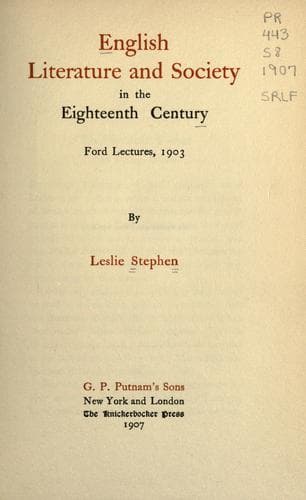
English Literature and Society in the Eighteenth CenturyStephen, Leslie
History
English Literature and Society in the Eighteenth Century
Stephen, Leslie
England -- Social life and customs -- 18th century; English literature -- 18th century -- History and criticism
who were beginning to become publishers, such as Strahan and the Dillys,
at whose house he had the famous meeting with the reprobate Wilkes. To
many of us, I suppose, an intimacy with that Johnsonian group has been a
first introduction to an interest in English literature. Thanks to
Boswell, we can hear its talk more distinctly than that of any later
circle. When we compare it to the society of an earlier time, one or two
points are conspicuous. Johnson's club was to some extent a continuation
of the clubs of Queen Anne's time. But the Wits of the earlier period
who met at taverns to drink with the patrons were a much smaller and
more dependent body. What had since happened had been the growth of a
great comfortable middle-class--meaning by middle-class the upper
stratum, the professional men, the lawyers, clergymen, physicians, the
merchants who had been enriched by the growth of commerce and
manufactures; the country gentlemen whose rents had risen, and who could
come to London and rub off their old rusticity. The aristocracy is still
in possession of great wealth and political power, but beneath it has
grown up an independent society which is already beginning to be the
most important social stratum and the chief factor in political and
social development. It has sufficient literary cultivation to admit the
distinguished authors and artists who are becoming independent enough to
take their place in its ranks and appear at its tables and rule the
conversation. The society is still small enough to have in the club a
single representative body and one man for dictator. Johnson succeeded
in this capacity to Pope, Dryden, and his namesake Ben, but he was the
last of the race. Men like Carlyle and Macaulay, who had a similar
distinction in later days, could only be leaders of a single group or
section in the more complex society of their time, though it was not yet
so multitudinous and chaotic as the literary class has become in our
own. Talk could still be good, because the comparatively small society
was constantly meeting, and each prepared to take his part in the game,
and was not being swept away distractedly into a miscellaneous vortex
of all sorts and conditions of humanity. Another fact is conspicuous.
The environment, we may say, of the man of letters was congenial. He
shared and uttered the opinions of the class to which he belonged.
Buckle gives a striking account of the persecution to which the French
men of letters were exposed at this period; Voltaire, Buffon, and
Rousseau, Diderot, Marmontel, and Morellet, besides a whole series of
inferior authors, had their books suppressed and were themselves either
exiled or imprisoned. There was a state of war in which almost the whole
literary class attacked the established creed while the rulers replied
by force instead of argument. In England men of letters were allowed,
with a few exceptions, to say what they thought, and simply shared the
average beliefs of their class and their rulers.
Public-domain text, read in full here on John Shaqi.
Reviews
Reviews
No reviews yet
Be the first to share your thoughts on this work.
Elsewhere in the archive
Join the Discussion
Join the discussion
Sign in to leave a comment or review.
Sign InorCreate an account