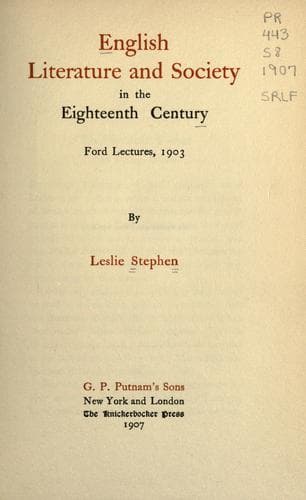
English Literature and Society in the Eighteenth CenturyStephen, Leslie
History
English Literature and Society in the Eighteenth Century
Stephen, Leslie
England -- Social life and customs -- 18th century; English literature -- 18th century -- History and criticism
If some leant towards
freethinking, the general tendency of the Johnson circle was harshly
opposed to any revolutionary movement, and authors were satisfied with
the creeds as with the institutions amid which they lived.
The English literary class was thus content to utter the beliefs
prevalent in the social stratum to which the chief writers belonged--a
stratum which had no special grievances and no revolutionary impulses,
and which could make its voice sufficiently heard though by methods
which led to no explicit change in the constitution, and suggests only a
change in the forces which really lay behind them. The chief political
changes mean for the present that 'public opinion' was acquiring more
power; that the newspaper press as its organ was especially growing in
strength; that Parliament was thrown open to the reporter, and speeches
addressed to the constituencies as well as to the Houses of Parliament,
and therefore the authority of the legislation becoming more amenable to
the opinions of the constituency. That is to say, again, that the
journalist and orator were growing in power and a corresponding
direction given to literary talent. The Wilkes agitation led to the
_Letters of Junius_--one of the most conspicuous models of the style of
the period; and some of the newspapers which were to live through the
next century began to appear in the following years. This period again
might almost be called the culminating period of English rhetoric. The
speeches of Pitt and Burke and Fox and Sheridan in the House of Commons
and at the impeachment of Warren Hastings must be regarded from the
literary as well as the political point of view, though in most cases
the decay of the temporary interests involved has been fatal to their
permanence. The speeches are still real speeches, intended to affect the
audience addressed, and yet partly intended also for the reporters. When
the audience becomes merely the pretext, and the real aim is to address
the public, the speech tends to become a pamphlet in disguise and loses
its rhetorical character. I may remark in passing that almost the only
legal speeches which, so far as my knowledge goes, are still readable,
were those of Erskine, who, after trying the careers of a sailor and a
soldier, found the true application for his powers in oratory. Though
his legal knowledge is said to have been slight, the conditions of the
time enabled him in addressing a British jury to put forward a political
manifesto and to display singular literary skill. Burke, however, is the
typical figure. Had he been a German he might have been a Lessing, and
the author of the _Sublime and Beautiful_ might, like the author of
_Laokoon_, have stimulated his countrymen by literary criticism. Or he
might have obtained a professorship or a court preachership and, like
Herder, have elaborated ideas towards the future of a philosophy of
history. In England he was drawn into the political vortex, and in that
Public-domain text, read in full here on John Shaqi.
Reviews
Reviews
No reviews yet
Be the first to share your thoughts on this work.
Elsewhere in the archive
Join the Discussion
Join the discussion
Sign in to leave a comment or review.
Sign InorCreate an account