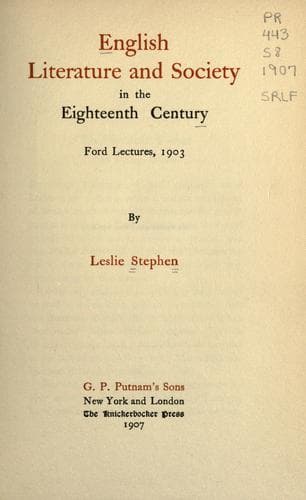
English Literature and Society in the Eighteenth CenturyStephen, Leslie
History
English Literature and Society in the Eighteenth Century
Stephen, Leslie
England -- Social life and customs -- 18th century; English literature -- 18th century -- History and criticism
capacity delivered speeches which also appeared as pamphlets, and which
must rank among the great masterpieces of English literature. I need not
inquire whether he lost more by giving to party what was meant for
mankind, or whether his philosophy did not gain more by the necessity of
constant application to the actual facts of the time. That necessity no
doubt limited both the amount and the systematic completeness of his
writings, though it also emphasised some of their highest merits. The
English political order tended in any case to divert a great deal of
literary ability into purely political channels--a peculiarity which it
has not yet lost. Burke is the typical instance of this combination, and
illustrates most forcibly the point to which I have already adverted.
Johnson, as we know, was a mass of obstinate Tory prejudice, and held
that the devil was the first Whig. He held at bottom, I think, that
politics touched only the surface of human life; that 'kings or laws,'
as he put it, can cause or cure only a small part of the evils which we
suffer, and that some authority is absolutely necessary, and that it
matters little whether it be the authority of a French monarch or an
English parliament. The Whig he thought objected to authority on
principle, and was therefore simply subversive. Something of the same
opinion was held by Johnson's circle in general. They were conservative
both in politics and theology, and English politics and theological
disputes did not obviously raise the deeper issues. Even the
devil-descended Whig--especially the variety represented by Burke--was
as far as possible from representing what he took for the diabolic
agency. Burke represents above all things the political application of
the historical spirit of the period. His hatred for metaphysics, for
discussions of abstract rights instead of practical expediency; his
exaltation of 'prescription' and 'tradition'; his admiration for
Montesquieu and his abhorrence of Rousseau; his idolatry of the British
constitution, and in short his whole political doctrine from first to
last, implies the profound conviction of the truth of the principles
embodied in a thorough historical method. Nobody, I think, was ever more
consistent in his first principles, though his horror of the Revolution
no doubt led him so to exaggerate one side of his teaching that he was
led to denounce some of the consequences which naturally followed from
other aspects of his doctrine. The schism between the old and the new
Whigs was not to be foreseen during this period, nor the coming into the
foreground of the deeper problems involved.
Public-domain text, read in full here on John Shaqi.
Reviews
Reviews
No reviews yet
Be the first to share your thoughts on this work.
Elsewhere in the archive
Join the Discussion
Join the discussion
Sign in to leave a comment or review.
Sign InorCreate an account