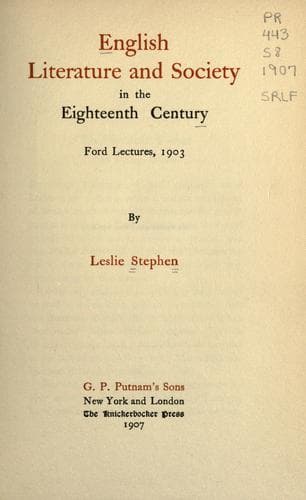
English Literature and Society in the Eighteenth CenturyStephen, Leslie
History
English Literature and Society in the Eighteenth Century
Stephen, Leslie
England -- Social life and customs -- 18th century; English literature -- 18th century -- History and criticism
I may now come to the purely literary movement. I have tried to show
that neither in philosophy, theology, nor political and social strata,
was there any belief in the necessity of radical changes, or prescience
of a coming alteration of the intellectual atmosphere. Speculation, like
politics, could advance quietly along the old paths without fearing that
they might lead to a precipice; and society, in spite of very vigorous
and active controversy upon the questions which decided it was in the
main self-satisfied, complacent, and comfortable. Adherence to the old
system is after all the general rule, and it is of the change not the
persistence that we require some account. At the beginning of our
period, Pope's authority was still generally admitted, although many
symptoms of discontent had appeared, and Warton was proposing to lower
him from the first to the second rank. The two most brilliant writers
who achieved fame in the early years of George III., Goldsmith and
Sterne, mark a characteristic moment in the literary development.
Goldsmith's poems the _Traveller_ (1765) and the _Deserted Village_
(1770), and the _Vicar of Wakefield_ (1766), are still on the old lines.
The poetry adopts Pope's versification, and implies the same ideal; the
desire for lucidity, sympathy, moderation, and the qualities which would
generally be connoted by classical. The substance, distinguished from
the style, shows the sympathy with sentimentalism of which Rousseau was
to be the great exponent. Goldsmith is beginning to denounce luxury--a
characteristic mark of the sentimentalist--and his regret for the period
when 'every rood of earth maintained its man' is one side of the
aspiration for a return to the state of nature and simplicity of
manners. The inimitable Vicar recalls Sir Roger de Coverley and the
gentle and delicate touch of Addison. But the Vicar is beginning to take
an interest in philanthropy. He is impressed by the evils of the old
prison system which had already roused Oglethorpe (who like
Goldsmith--as I may notice--disputed with Johnson as to the evils of
luxury) and was soon to arouse Howard. The greatest attraction of the
Vicar is due to the personal charm of Goldsmith's character, but his
character makes him sympathise with the wider social movements and the
growth of genuine philanthropic sentiment. Goldsmith, in his remarks
upon the _Present State of Polite Learning_ (1759), explains the decay
of literature (literature is always decaying) by the general enervation
which accompanies learning and the want of originality caused by the
growth of criticism. That was not an unnatural view at a time when the
old forms are beginning to be inadequate for the new thoughts which are
seeking for utterance. As yet, however, Goldsmith's own work proves
sufficiently that the new motive could be so far adapted to the old form
as to produce an artistic masterpiece. Sterne may illustrate a similar
remark.
Public-domain text, read in full here on John Shaqi.
Reviews
Reviews
No reviews yet
Be the first to share your thoughts on this work.
Elsewhere in the archive
Join the Discussion
Join the discussion
Sign in to leave a comment or review.
Sign InorCreate an account