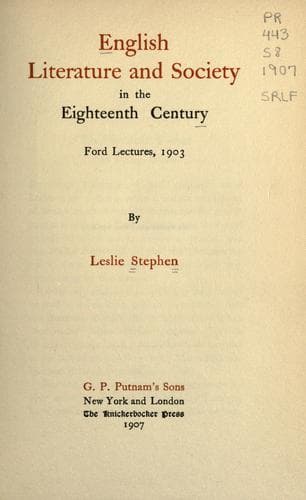
English Literature and Society in the Eighteenth CenturyStephen, Leslie
History
English Literature and Society in the Eighteenth Century
Stephen, Leslie
England -- Social life and customs -- 18th century; English literature -- 18th century -- History and criticism
interesting phenomenon. Even the greatest man has to live in his own
century. The deepest thinker is not really--though we often use the
phrase--in advance of his day so much as in the line along which advance
takes place. The greatest poet does not write for a future generation in
the sense of not writing for his own; it is only that in giving the
fullest utterance to its thoughts and showing the deepest insight into
their significance, he is therefore the most perfect type of its general
mental attitude, and his work is an embodiment of the thoughts which are
common to men of all generations.
When the critic began to perceive that many forms of art might be
equally legitimate under different conditions, his first proceeding was
to classify them in different schools. English poets, for example, were
arranged by Pope and Gray as followers of Chaucer, Spenser, Donne,
Dryden, and so forth; and, in later days, we have such literary genera
as are indicated by the names classic and romantic or realist and
idealist, covering characteristic tendencies of the various historical
groups. The fact that literary productions fall into schools is of
course obvious, and suggests the problem as to the cause of their rise
and decline. Bagehot treats the question in his _Physics and Politics_.
Why, he asks, did there arise a special literary school in the reign of
Queen Anne--'a marked variety of human expression, producing what was
then written and peculiar to it'? Some eminent writer, he replies, gets
a start by a style congenial to the minds around him. Steele, a rough,
vigorous, forward man, struck out the periodical essay; Addison, a wise,
meditative man, improved and carried it to perfection. An unconscious
mimicry is always producing countless echoes of an original writer.
That, I take it, is undeniably true. Nobody can doubt that all authors
are in some degree echoes, and that a vast majority are never anything
else. But it does not answer why a particular form should be fruitful of
echoes or, in Bagehot's words, be 'more congenial to the minds around.'
Why did the _Spectator_ suit one generation and the _Rambler_ its
successors? Are we incapable of giving any answer? Are changes in
literary fashions enveloped in the same inscrutable mystery as changes
in ladies' dresses? It is, and no doubt always will be, impossible to
say why at one period garments should spread over a hoop and at another
cling to the limbs. Is it equally impossible to say why the fashion of
Pope should have been succeeded by the fashion of Wordsworth and
Coleridge? If we were prepared to admit the doctrine of which I have
spoken--the supreme importance of the individual--that would of course
be all that could be said. Shakespeare's successors are explained as
imitators of Shakespeare, and Shakespeare is explained by his 'genius'
or, in other words, is inexplicable. If, on the other hand,
Shakespeare's originality, whatever it may have been, was shown by his
Public-domain text, read in full here on John Shaqi.
Reviews
Reviews
No reviews yet
Be the first to share your thoughts on this work.
Join the Discussion
Join the discussion
Sign in to leave a comment or review.
Sign InorCreate an account