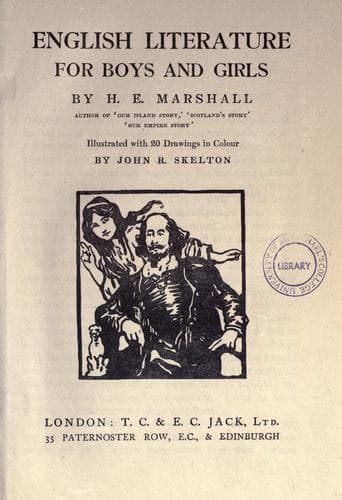
English Literature for Boys and GirlsMarshall, H. E. (Henrietta Elizabeth)
History
English Literature for Boys and Girls
Marshall, H. E. (Henrietta Elizabeth)
English literature -- History and criticism
So after a time we find him no longer a friar, but a courtier.
Soon we find him, like Chaucer, being sent on business to the
Continent for his King, James IV. Like Chaucer he receives
pensions; like Chaucer, too, he knows sometimes what it is to be
poor, and he has left more than one poem in which he prays the
King to remember his old and faithful servant and not leave him
in want. We find him also begging the King for a Church living,
for although he had no mind to be a friar, he wanted a living,
perhaps merely that he might be sure of a home in his old age.
But for some reason the King never gave him what he asked.
We have nearly ninety poems of Dunbar, none of them very long.
But although he is a far better poet than Barbour, or even
perhaps than James I, he is not for you so interesting in the
meantime. First, his language is very hard to understand. One
reason for this is that he knows so many words and uses them all.
"He language had at large," says one of his fellow poets and
countrymen.* And so, although his thought is always clear, it is
not always easy to follow it through his strange words. Second,
his charm as a poet lies not so much in what he tells, not so
much in his story, as in the way that he tells it. And so, even
if you are already beginning to care for words and the way in
which they are used, you may not yet care so much that you can
enjoy poetry written in a tongue which, to us is almost a foreign
tongue. But if some day you care enough about it to master this
old-world poet, you will find that there is a wonderful variety
in his poems. He can be glad and sad, tender and fierce.
Sometimes he seems to smile gently upon the sins and sorrows of
his day, at other times he pours forth upon them words of savage
scorn, grim and terrible. But when we take all his work
together, we find that we have such a picture of the times in
which he lived as perhaps only Chaucer besides has given us.
*Sir David Lyndsay.
For us the most interesting poem is The Thistle and the Rose.
This was written when Margaret, the daughter of King Henry VII of
England, came to be the wife of King James IV of Scotland.
Dunbar was the "Rhymer of Scotland," that is the poet-laureate of
his day, and so, as was natural, he made a poem upon this great
event. For a poet-laureate is the King's poet, and it is his
duty to make poems on all the great things that may happen to the
King. For this he receives a certain amount of money and a cask
of wine every year. But it is the honor and not the reward which
is now prized.
Dunbar begins by telling us that he lay dreaming one May morning.
You will find when you come to read much of the poetry of those
days, that poets were very fond of making use of a dream by which
to tell a story. It was then a May morning when Dunbar lay
asleep.
Public-domain text, read in full here on John Shaqi.
Reviews
Reviews
No reviews yet
Be the first to share your thoughts on this work.
Elsewhere in the archive
Join the Discussion
Join the discussion
Sign in to leave a comment or review.
Sign InorCreate an account