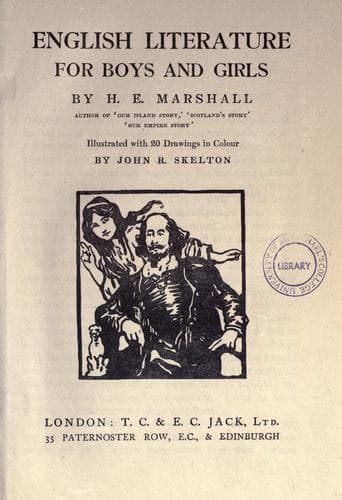
English Literature for Boys and GirlsMarshall, H. E. (Henrietta Elizabeth)
History
English Literature for Boys and Girls
Marshall, H. E. (Henrietta Elizabeth)
English literature -- History and criticism
"When March was with varying winds past,
And April had, with her silver showers,
Tane leave of nature with an orient blast;
And pleasant May, that mother is of flowers,
Had made the birds to begin their hours*
Among the tender arbours red white,
Whose harmony to hear it was delight."
*Orisons - morning prayers.
Then it seemed that May, in the form of a beautiful lady, stood
beside his bed. She called to him, "Sluggard, awake anon for
shame, and in mine honor go write something."
"'What,' quoth I, ' shall I wuprise at morrow?'
For in this May few birdies heard I sing.
'They have more cause to weep and plain their sorrow,
Thy air it is not wholesome or benign!'"
"Nevertheless rise," said May. And so the lazy poet rose and
followed the lady into a lovely garden. Here he saw many
wonderful and beautiful sights. He saw all the birds, and
beasts, and flowers in the world pass before Dame Nature.
"Then calléd she all flowers that grew in field,
Discerning all their fashions and properties;
Upon the awful Thistle she beheld,
And saw him keepéd* by a bush of spears;
Considering him so able for the wars,
A radiant crown of rubies she him gave,
And said, 'In field go forth, and fend the lave.**
And, since thou art a king, be thou discreet,
Herb without virtue hold thou not of such price
As herb of virtue and of odour sweet;
And let no nettle vile, and full of vice,
Mate him to the goodly fleur-de-lis,
Nor let no wild weed full of churlishness
Compare her to the lily's nobleness.
Nor hold thou no other flower in such dainty
As the fresh Rose, of colour red and white;
For if thou dost, hurt is thine honesty
Considering that no flower is so perfect,
So full of virtue, pleasance and delight,
So full of blissful angelic beauty,
Imperial birth, honour and dignity.'"
*Guarded.
**Rest = others.
By the Thistle, of course, Dunbar means James IV, and by the Rose
the Princess Margaret.
Then to the Rose Dame Nature spoke, and crowned her with "a
costly crown with shining rubies bright." When that was done all
the flowers rejoiced, crying out, "Hail be thou, richest Rose."
Then all the birds - the thrush, the lark, the nightingale--cried
"Hail," and "the common voice uprose of birdies small" till all
the garden rang with joy.
"Then all the birdies sang with such a shout,
That I anon awoke where that I lay,
And with a start I turnéd me about
To see this court: but all were went away:
Then up I leanéd, half yet in fear,
And thus I wrote, as ye have heard to forrow,*
Of lusty May upon the nineth morrow."
*Before = already.
Public-domain text, read in full here on John Shaqi.
Reviews
Reviews
No reviews yet
Be the first to share your thoughts on this work.
Elsewhere in the archive
Join the Discussion
Join the discussion
Sign in to leave a comment or review.
Sign InorCreate an account