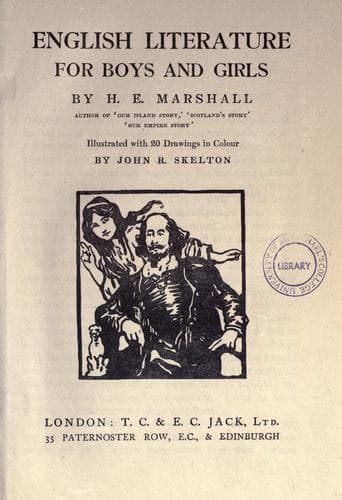
English Literature for Boys and GirlsMarshall, H. E. (Henrietta Elizabeth)
History
English Literature for Boys and Girls
Marshall, H. E. (Henrietta Elizabeth)
English literature -- History and criticism
We know that Caxton printed at least one hundred and two editions
of books. And you will be surprised to hear that of all these
only two or three were books of poetry. Here we have a sure sign
that the singing time was nearly over. I do not mean that we are
to have no more singers, for most of our greatest are still to
come. But from this time prose had shaken off its fetters. It
was no longer to be used only for sermons, for prayers, for
teaching. It was to take its place beside poetry as a means of
enjoyment - as literature. Literature, then, was no longer the
affair of the market-place and the banqueting-hall, but of a
man's own fireside and quiet study. It was no longer the affair
of the crowd, but of each man to himself alone.
The chief poems which Caxton printed were Chaucer's. In one
place he calls Chaucer "The worshipful father and first founder
and embellisher of ornate eloquence in our English." Here, I
think, he shows that he was trying to follow the advice of "those
honest and great clerks" who told him he should write "the most
curious terms" that he could find. But certainly he admired
Chaucer very greatly. In the preface to his second edition of
the Canterbury Tales he says, "Great thank, laud and honour ought
to be given unto the clerks, poets" and others who have written
"noble books." "Among whom especially before all others, we
ought to give a singular laud unto that noble and great
philosopher, Geoffrey Chaucer." Then Caxton goes on to tell us
how hard he had found it to get a correct copy of Chaucer's
poems, "For I find many of the said books which writers have
abridged it, and many things left out: and in some places have
set verses that he never made nor set in his book."
This shows us how quickly stories became changed in the days when
everything was copied by hand. When Caxton wrote these words
Chaucer had not been dead more than about eighty years, yet
already it was not easy to find a good copy of his works.
And if stories changed, the language changed just as quickly.
Caxton tells us that the language was changing so fast that he
found it hard to read books written at the time he was born. His
own language is very Frenchy, perhaps because he translated so
many of his books from French. He not only uses words which are
almost French, but arranges his sentences in a French manner. He
often, too drops the e in the, just as in French the e or a in le
and la is dropped before a vowel. This you will often find in
old English books. "The abbey" becomes thabbay, "The English"
thenglish. Caxton writes, too, thensygnementys for "the
teaching." Here we have the dropped e and also the French word
enseignement used instead of "teaching." But these were only
last struggles of a foreign tongue. The triumphant English we
now possess was already taking form.
Public-domain text, read in full here on John Shaqi.
Reviews
Reviews
No reviews yet
Be the first to share your thoughts on this work.
Elsewhere in the archive
Join the Discussion
Join the discussion
Sign in to leave a comment or review.
Sign InorCreate an account