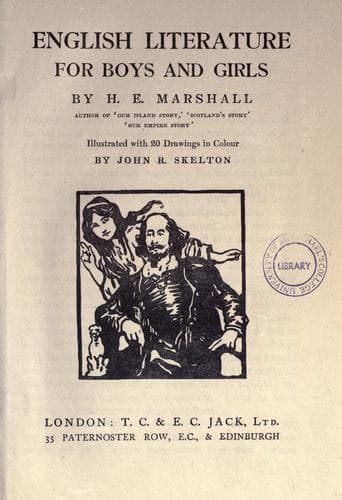
English Literature for Boys and GirlsMarshall, H. E. (Henrietta Elizabeth)
History
English Literature for Boys and Girls
Marshall, H. E. (Henrietta Elizabeth)
English literature -- History and criticism
But it was not by printing alone that in the fifteenth century
men's eyes were opened to new wonder. They were also opened to
the wonder of a new world far over the sea. For the fifteenth
century was the age of discovery, and of all the world's first
great sailors. It was the time when America and the western
isles were discovered, when the Cape of Good Hope was first
rounded, and the new way to India found. So with the whole world
urged to action by the knowledge of these new lands, with
imagination wakened by the tales of marvels to be seen there,
with a new desire to see and do stirring in men's minds, it was
not wonderful that there should be little new writing. The
fifteenth century was the age of new action and new worlds. The
new thought was to follow.
YEAR 8
Chapter XXXII ABOUT THE BEGINNING OF THE THEATER
MANY of you have, no doubt, been to the theater. You have seen
pantomimes and Peter Pan, perhaps; perhaps, too, a play of
Shakespeare, - a comedy, it may be, which made you laugh, or even
a tragedy which made you want to cry, or at least left you sad.
Some of you, too, have been to "Pageants," and some may even have
been to an oratorio, which last may have been sung in a church.
But did you ever wonder how plays and theaters came to be? Did
you ever think that there was a time when in all the length and
breadth of the land there was no theater, when there were no
plays either merry or sad? Yet it was so. But at a very early
time the people of England began to act. And, strange as it may
seem to us now, the earliest plays were acted by monks and took
place in church. And it is from these very early monkish plays
that the theater with its different kinds of plays, that pageants
and even oratorios have sprung.
In this chapter I am going to talk about these beginnings of the
English theater and of its literature. All plays taken together
are called the drama, and the writers of them are called
dramatists, from a Greek word dran, to act or do. For dramas are
written not to be read merely, but also to be acted.
To trace the English drama from its beginnings we must go a long
way back from the reigns of Henry VII and of Henry VIII, down to
which the life of Dunbar has brought us. We must go back to the
days when the priests were the only learned people in the land,
when the monasteries were the only schools.
Public-domain text, read in full here on John Shaqi.
Reviews
Reviews
No reviews yet
Be the first to share your thoughts on this work.
Elsewhere in the archive
Join the Discussion
Join the discussion
Sign in to leave a comment or review.
Sign InorCreate an account