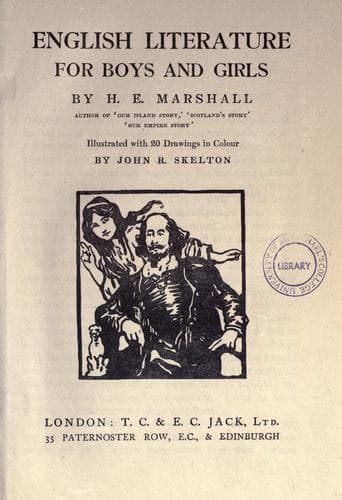
English Literature for Boys and GirlsMarshall, H. E. (Henrietta Elizabeth)
History
English Literature for Boys and Girls
Marshall, H. E. (Henrietta Elizabeth)
English literature -- History and criticism
The very first of our Moralities seems to have been a play of the
Lord's Prayer. It was acted in the reign of Edward III or some
time after 1327. But that has long been lost, and we know
nothing of it but its name. There are several other Moralities,
however, which have come down to us of a later date, the earliest
being of the fifteenth century, and of them perhaps the most
interesting is Everyman.
But we cannot claim Everyman altogether as English literature,
for it is translated from, or at least founded upon, a Dutch
play. Yet it is the best of all the Moralities which have come
down to us, and may have been translated into English about 1480.
In its own time it must have been thought well of, or no one
would have troubled to translate it. But, however popular it was
long ago, for hundreds of years it had lain almost forgotten,
unread except by a very few, and never acted at all, until some
one drew it from its dark hiding-place and once more put it upon
the stage. Since then, during the last few years, it has been
acted often. And as, happily, the actors have tried to perform
it in the simple fashion in which it must have been done long
ago, we can get from it a very good idea of the plays which
pleased our forefathers. On the title-page of Everyman we read:
"Here beginneth a treatise how the high Father of heaven sendeth
Death to summon every creature to come to give a count of their
lives in this world, and is in the manner of a moral play." So
in the play we learn how Death comes to Everyman and bids him
follow him.
But Everyman is gay and young. He loves life, he has many
friends, the world to him is beautiful, he cannot leave it. So
he prays Death to let him stay, offers him gold and riches if he
will but put off the matter until another day.
But Death is stern. "Thee availeth not to cry, weep and pray,"
he says, "but haste thee lightly that thou wert gone the
journey."
Then seeing that go he must, Everyman thinks that at least he
will have company on the journey. So he turns to his friends.
But, alas, none will go with him. One by one they leave him.
Then Everyman cries in despair:--
"O to whom shall I make my moan
For to go with me in that heavy journey?
First Fellowship said he would with me gone;
His words were very pleasant and gay,
But afterward he left me alone.
Then spake I to my kinsmen all in despair,
And also they gave me words fair;
They lacked no fair speaking,
But all forsake me in the ending."
Public-domain text, read in full here on John Shaqi.
Reviews
Reviews
No reviews yet
Be the first to share your thoughts on this work.
Elsewhere in the archive
Join the Discussion
Join the discussion
Sign in to leave a comment or review.
Sign InorCreate an account