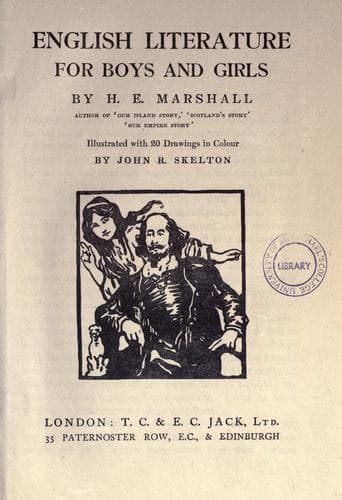
English Literature for Boys and GirlsMarshall, H. E. (Henrietta Elizabeth)
History
English Literature for Boys and Girls
Marshall, H. E. (Henrietta Elizabeth)
English literature -- History and criticism
So at last Everyman turns him to his Good Deeds--his Good Deeds,
whom he had almost forgotten and who lies bound and in prison by
reason of his sins. And Good Deeds consents to go with him on
the dread journey. With him come others, too, among them
Knowledge and Strength. But at the last these, too, turn back.
Only Good Deeds is true, only Good Deeds stands by him to the end
with comforting words. And so the play ends; the body of
Everyman is laid in the grave, but we know that his soul goes
home to God.
This play is meant to picture the life of every man or woman, and
to show how unhappy we may be in the end if we have not tried to
be good in this world.
"This moral men may have in mind,
The hearers take it of worth old and young,
And forsake Pride, for he deceiveth you in the end,
And remember Beauty, Five Wits, Strength, and Discretion,
They all at the last do Everyman forsake,
Save his Good Deeds; these doth he take.
And beware, - an they be small,
Before God he hath no help at all.
None excuse may be there for Everyman."
BOOKS TO READ
Everyman: A Morality (Everyman's Library).
Chapter XXXV HOW A POET COMFORTED A GIRL
PERHAPS the best Morality of which we know the author's name is
Magnificence, by John Skelton. But, especially after Everyman,
it is dull reading for little people, and it is not in order to
speak of this play that I write about Skelton.
John Skelton lived in the stormy times of Henry VIII, and he is
called sometimes our first poet-laureate. But he was not poet-
laureate as we now understand it, he was not the King's poet.
The title only meant that he had taken a degree in grammar and
Latin verse, and had been given a laurel wreath by the university
which gave the degree. It was in this way that Skelton was made
laureate, first by Oxford, then by Louvain in Belgium, and
thirdly by Cambridge, so that in his day he was considered a
learned man and a great poet. He was a friend of Caxton and
helped him with one of his books. "I pray, maister Skelton, late
created poet-laureate in the university of Oxenford," says
Caxton, "to oversee and correct this said book."
John Skelton, like so many other literary men of those days, was
a priest. He studied, perhaps, both at Oxford and at Cambridge,
and became tutor to Prince, afterwards King, Henry VIII. We do
not know if he had an easy time with his royal pupil or not, but
in one of his poems he tells us that "The honour of England I
learned to spell" and "acquainted him with the Muses nine."
The days of Henry VIII were troublous times for thinking people.
The King was a tyrant, and the people of England were finding it
harder than ever to bow to a tyrant while the world was awakening
to new thought, and new desires for freedom, both in religion and
in life.
Public-domain text, read in full here on John Shaqi.
Reviews
Reviews
No reviews yet
Be the first to share your thoughts on this work.
Elsewhere in the archive
Join the Discussion
Join the discussion
Sign in to leave a comment or review.
Sign InorCreate an account