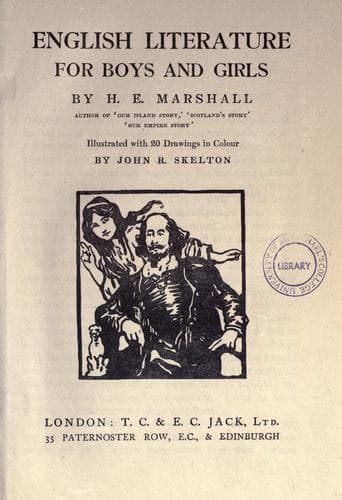
English Literature for Boys and GirlsMarshall, H. E. (Henrietta Elizabeth)
History
English Literature for Boys and Girls
Marshall, H. E. (Henrietta Elizabeth)
English literature -- History and criticism
Thus Constantinople was the Christian outpost of Europe. For
hundred of year the Byzantine Empire stood as a barrier against
the Saracen hosts of Asia. It might have stood still longer, but
sad to say, this barrier was first broken down by the Christians
themselves. For in 1204 the armies of the fourth Crusade, which
had gathered to fight the heathen, turned their swords, to their
shame be it said, against the Christian people of the Greek
Empire. Constantinople was taken, plundered, and destroyed by
these "pious brigands,"* and the last of the Byzantine Emperors
was first blinded and then flung from a high tower, so that his
body fell shattered to pieces on the paving-stones of his own
capital.
*George Finlay, History of Greece.
Baldwin, Count of Flanders, one of the great leaders of the
Crusade, was then crowned by his followers and acknowledged
Emperor of the East. But the once great Empire was now broken
up, and out of it three lesser Empires, as well as many smaller
states, were formed.
Baldwin did not long rule as Emperor of the East, and the Greeks
after a time succeeded in regaining Constantinople from the
western Christians. But although for nearly two hundred years
longer they kept it, the Empire was dying and lifeless. And by
degrees, as the power of Greece grew less, the power of Turkey
grew greater. At length in 1453 the Sultan Mohammed II attacked
Constantinople. Then the Cross, which for a thousand years and
more had stood upon the ramparts of Christendom, went down before
the Crescent.
Constantine XI, the last of the Greek Emperors, knelt in the
great church of St. Sophia to receive for the last time the Holy
Sacrament. Then mounting his horse he rode forth to battle.
Fighting for his kingdom and his faith he fell, and over his dead
body the young Sultan and his soldiers rode into the ruined city.
Then in the church, where but a few hours before the fallen
Emperor had knelt and prayed to Christ, the Sultan bowed himself
in thanks and praise to Allah and Mohammed.
And now we come to the point where the taking of Constantinople
and the fall of the Greek Empire touches our literature.
In Constantinople the ancient learning and literature of the
Greeks had lived on year after year. The city was full of
scholars who knew, and loved, and studied the Greek authors. But
now, before the terror of the Turk, driven forth by the fear of
slavery and disgrace, these Greek scholars fled. They fled to
Italy. And although in their flight they had to leave goods and
wealth behind, the came laden with precious manuscripts from the
libraries of Constantinople.
These fugitive Greeks brought to the Italians a learning which
was to them new and strange. Soon all over Europe the news of
the New Learning spread. Then across the Alps scholars thronged
from every country in Europe to listen and to learn.
Public-domain text, read in full here on John Shaqi.
Reviews
Reviews
No reviews yet
Be the first to share your thoughts on this work.
Elsewhere in the archive
Join the Discussion
Join the discussion
Sign in to leave a comment or review.
Sign InorCreate an account