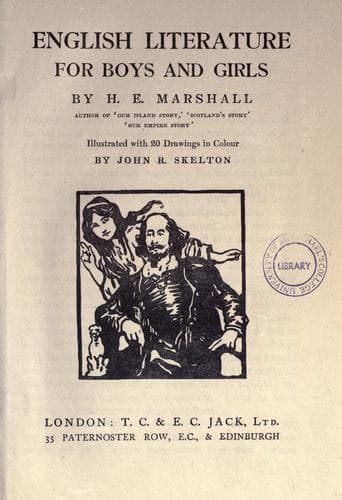
English Literature for Boys and GirlsMarshall, H. E. (Henrietta Elizabeth)
History
English Literature for Boys and Girls
Marshall, H. E. (Henrietta Elizabeth)
English literature -- History and criticism
I do not think I can quite make you understand what this New
Learning was. It was indeed but the old learning of Greece. Yet
there was in it something that can never grow old, for it was
human. It made men turn away from idle dreaming and begin to
learn that the world we live in is real. They began to realize
that there was something more than a past and a future. There
was the present. So, instead of giving all their time to vague
wonderings of what might be, of what never had been, and what
never could be, they began to take an interest in life as it was
and in man as he was. They began to see that human life with all
its joys and sorrows was, after all, the most interesting thing
to man.
It was a New Birth, and men called it so. For that is the
meaning of Renaissance. Many things besides the fall of
Constantinople helped towards this New Birth. The discovery of
new worlds by daring sailors like Columbus and Cabot, and the
discovery of printing were among them. But the touchstone of the
New Learning was the knowledge of Greek, which had been to the
greater part of Europe a lost tongue. On this side of the Alps
there was not a school or college in which it could be learned.
So to Italy, where the Greek scholars had found a refuge, those
who wished to learn flocked.
Among them were some Oxford scholars. Chief of these were three,
whose names you will learn to know well when you come to read
more about this time. They were William Grocyn, "the most
upright and best of all Britons,"* Thomas Linacre, and John
Colet. These men, returning from Italy full of the New Learning,
began to teach Greek at Oxford. And it is strange now to think
that there were many then who were bitterly against such
teaching. The students even formed themselves into two parties,
for and against. They were called Greeks and Trojans, and
between these two parties man a fierce fight took place, for the
quarrel did not end in words, but often in blows.
*Erasmus.
The New Learning, however, conquered. And so keenly did men feel
the human interests of such things as were now taught, that we
have come to call grammar, rhetoric, poetry, Greek and Latin the
Humanities, and the professor who teaches these thing the
professor of Humanity.
Chapter XXXVII THE LAND OF NOWHERE
WHILE the New Learning was stirring England, and Greek was being
for the first time taught in Oxford, a young student of fourteen
came to the University there. This student was named Thomas
More. He was the son of a lawyer who became a judge, and as a
little boy he had been a page in the household of Morton, the
Archbishop of Canterbury.
The Archbishop was quick to see that the boy was clever. "This
child here waiting at the table, whoever will live to see it,
will prove a marvellous man,"* he would say. And so he persuaded
More's father to send the boy to Oxford to study law.
*William Roper, The Mirrour of Virtue.
Public-domain text, read in full here on John Shaqi.
Reviews
Reviews
No reviews yet
Be the first to share your thoughts on this work.
Elsewhere in the archive
Join the Discussion
Join the discussion
Sign in to leave a comment or review.
Sign InorCreate an account