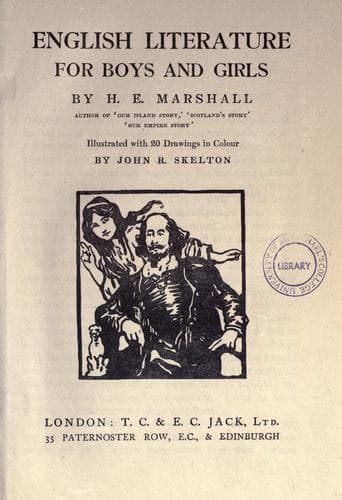
English Literature for Boys and GirlsMarshall, H. E. (Henrietta Elizabeth)
History
English Literature for Boys and Girls
Marshall, H. E. (Henrietta Elizabeth)
English literature -- History and criticism
Thomas remained only two years at Oxford, for old Sir John,
fearing he was learning too much Greek and literature and not
enough law, called his son home and sent him to study law in
London. It must have been a disappointment to the boy to be
taken from the clever friends he had made in Oxford, and from the
books and studies that he loved, to be set instead to read dry
law-books. But Thomas More was most sunny-tempered. Nothing
made him sulky or cross. So now he settled down quietly to his
new life, and in a very short time became a famous and learned
lawyer.
In was after More left Oxford that he met the man who became his
dearest friend. This was Desiderius Erasmus, a learned Dutchman.
He was eleven years older than More and he could speak no
English, but that did not prevent them becoming friends, as they
both could speak Latin easily and well. They had much in common.
Erasmus was of the same lively, merry wit as More, they both
loved literature and the Greek learning, and so the two became
fast friends. And it helps us to understand the power which
Latin still held over our literature, and indeed over all the
literature of Europe, when we remember that these two friends
spoke to each other and wrote and jested in Latin as easily as
they might have done in English. Erasmus was one of the most
famous men of his time. He was one who did much in his day to
free men's minds, one who helped men to think for themselves. So
although he had directly perhaps little to do with English
literature, it is well to remember him as the friend of More.
"My affection for the man is so great," wrote Erasmus once, "that
if he bade me dance a hornpipe, I should do at once what he bid
me."
Although More was so merry and witty, religion got a strong hold
upon him, and at one time he thought of becoming a monk. But his
friends persuaded him to give up that idea, and after a time he
decided to marry. He chose his wife in a somewhat quaint manner.
Among his friends there was a gentleman who had three daughters.
More liked the second one best, "for that he thought her the
fairest and best favoured."* But he married the eldest because
it seemed to him "that it would be both great grief and some
shame also to the oldest to see her younger sister preferred
before her in marriage. He then, of a certain pity, framed his
fancy toward her, and soon after married her."*
*W. Roper.
Although he chose his wife so quaintly More's home was a very
happy one. He loved nothing better than to live a simple family
life with his wife and children round him. After six years his
wife died, but he quickly married again. And although his second
wife was "a simple ignorant woman and somewhat worldly too," with
a sharp tongue and short temper, she was kind to her step-
children and the home was still a happy one.
Public-domain text, read in full here on John Shaqi.
Reviews
Reviews
No reviews yet
Be the first to share your thoughts on this work.
Elsewhere in the archive
Join the Discussion
Join the discussion
Sign in to leave a comment or review.
Sign InorCreate an account