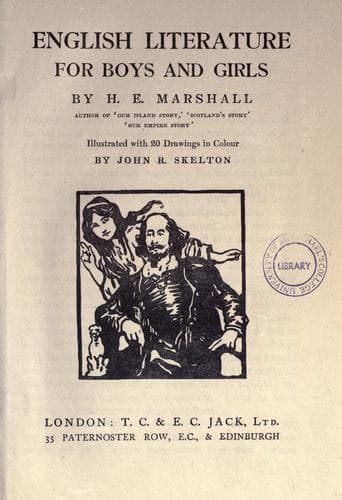
English Literature for Boys and GirlsMarshall, H. E. (Henrietta Elizabeth)
History
English Literature for Boys and Girls
Marshall, H. E. (Henrietta Elizabeth)
English literature -- History and criticism
More was a great public man, but he was first a father and head
of his own house. He says: "While I spend almost all the day
abroad amongst others, and the residue at home among mine own, I
leave to myself, I mean to my book, no time. For when I come
home, I must commen with my wife, chatter with my children, and
talk with my servants. All the which things I reckon and account
among business, forasmuch as they must of necessity be done, and
done must they needs be unless a man will be stranger in his own
home. And in any wise a man must so fashion and order his
conditions and so appoint and dispose himself, that he be merry,
jocund and pleasant among them, whom either Nature hath provided
or chance hath made, or he himself hath chosen to be the fellows
and companions of his life, so that with too much gentle
behaviour and familiarity he do not mar them, and by too much
sufferance of his servants make them his masters."
At a time, too, when education was thought little necessary for
girls, More taught his daughters as carefully as his sons. His
eldest daughter Margaret (Mog, as he loved to call her) was so
clever that learned men praised and rewarded her. When his
children married they did not leave home, but came with their
husbands and wives to live at Chelsea in the beautiful home More
had built there. So the family was never divided, and More
gathered a "school" of children and grandchildren round him.
More soon became a great man. Henry VII, indeed, did not love
him, so More did not rise to power while he lived. But Henry VII
died and his son Henry VIII ruled. The great Chancellor,
Cardinal Wolsey, became More's friend, and presently he was sent
on business for the King to Bruges.
It was while More was about the King's business in Belgium that
he wrote the greater part of the book by which he is best
remembered. This book is called Utopia. The name means
"nowhere," from two Greek words, "ou," no, and "topos," a place.
The Utopia, like so many other books of which we have read, was
the outcome of the times in which the writer lived. When More
looked round upon the England that he knew he saw many things
that were wrong. He was a man loyal to his King, yet he could
not pretend to think that the King ruled only for the good of his
people and not for his own pleasure. There was evil, misery, and
suffering in all the land. More longed to make people see that
things were wrong; he longed to set the wrong right. So to teach
men how to do this he invented a land of Nowhere in which there
was no evil or injustice, in which every one was happy and good.
He wrote so well about that make-believe land that from then till
now every one who read Utopia sees the beauty of More's idea.
But every one, too, thinks that this land where everything is
right is an impossible land. Thus More gave a new word to our
language, and when we think some idea beautiful but impossible we
call it "Utopian."
Public-domain text, read in full here on John Shaqi.
Reviews
Reviews
No reviews yet
Be the first to share your thoughts on this work.
Elsewhere in the archive
Join the Discussion
Join the discussion
Sign in to leave a comment or review.
Sign InorCreate an account