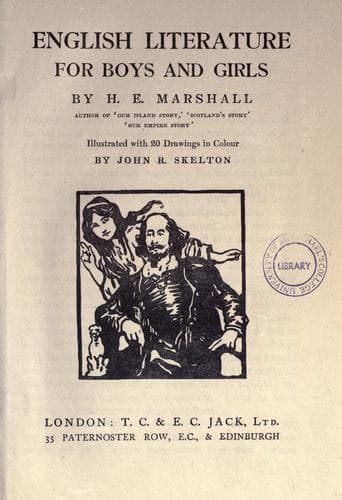
English Literature for Boys and GirlsMarshall, H. E. (Henrietta Elizabeth)
History
English Literature for Boys and Girls
Marshall, H. E. (Henrietta Elizabeth)
English literature -- History and criticism
Henry grew tired of his wife, Queen Catherine, but the Pope would
not allow him to divorce her so that he might marry another.
Then Henry quarreled with the Pope. The Pope, he said, should no
longer have power in England. He should no longer be head of the
Church, but the people must henceforth look to the King as such.
This More could not do. He tried to keep out of the quarrel. He
was true to his King as king, but he felt that he must be true to
his religion too. To him the Pope was the representative of
Christ on earth, and he could look to no other as head of the
Church. When first More had come into the King's service, Henry
bade him "first look unto God, and after God unto him." Of this
his Chancellor now reminded him, and laying down his seal of
office he went home, hoping to live the rest of his days in
peace.
But that was not to be. "It is perilous striving with princes,"
said a friend. " I would wish you somewhat to incline to the
King's pleasure. The anger of princes is death."
"Is that all?" replied More calmly; "then in good faith the
difference between you and me is but this, that I shall die to-
day and you to-morrow."
So it fell out. There came a day when messengers came to More's
happy home, and the beloved father was led away to imprisonment
and death.
For fifteen months he was kept in the Tower. During all that
time his cheerful steadfastness did not waver. He wrote long
letters to his children, and chiefly to Meg, his best-loved
daughter. When pen and ink were taken away from him, he still
wrote with coal. In these months he became an old man, bent and
crippled with disease. But though his body was feeble his mind
was clear, his spirit bright as ever. No threats or promises
could shake his purpose. He could not and would not own Henry as
head of the Church.
At last the end came. In Westminster Hall More was tried for
treason and found guilty. From Westminster through the thronging
streets he was led back again to the Tower. In front of the
prisoner an ax was carried, the edge being turned towards him.
That was the sign to all who saw that he was to die.
As the sad procession reached the Tower Wharf there was a pause.
A young and beautiful woman darted from the crowd, and caring not
for the soldiers who surrounded him, unafraid of their swords and
halberds, she reached the old man's side, and threw herself
sobbing on his breast. In was Margaret, More's beloved daughter,
who, fearing that never again she might see her father, thus came
in the open street to say farewell. She clung to him and kissed
him in sight of all again and again, but no word could she say
save, "Oh, my father! oh, my father!"
Public-domain text, read in full here on John Shaqi.
Reviews
Reviews
No reviews yet
Be the first to share your thoughts on this work.
Elsewhere in the archive
Join the Discussion
Join the discussion
Sign in to leave a comment or review.
Sign InorCreate an account