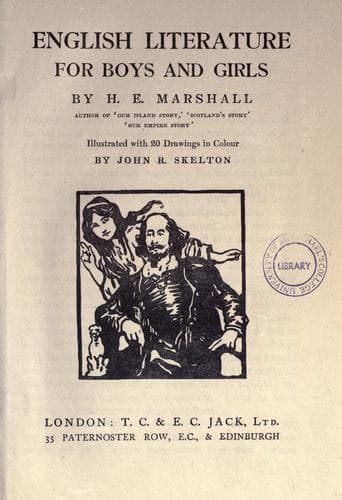
English Literature for Boys and GirlsMarshall, H. E. (Henrietta Elizabeth)
History
English Literature for Boys and Girls
Marshall, H. E. (Henrietta Elizabeth)
English literature -- History and criticism
Then Sir Thomas, holding her tenderly, comforted and blessed her,
and at last she took her arms from about his neck and he passed
on. But Margaret could not yet leave him. Scarcely had she gone
ten steps than suddenly she turned back. Once more breaking
through the guard she threw her arms about him. Not a word did
Sir Thomas say, but as he held her there the tears fell fast from
his eyes, while from the crowd around broke the sound of weeping.
Even the guards wept for pity. But at last, with full and heavy
hearts, father and daughter parted.
"Dear Meg," Sir Thomas wrote for the last time, "I never liked
your manner better towards me than when you kissed me last. For
I like when daughterly love and dear charity hath no leisure to
look to worldly courtesy."
Next day he died cheerfully as he had lived. To the last he
jested in his quaint fashion. The scaffold was so badly built
that it was ready to fall, so Sir Thomas, jesting, turned to the
lieutenant. "I pray you, Master Lieutenant," he said, "see me
safe up, and for my coming down let me shift for myself." He
desired the people to pray for him, and having kissed the
executioner in token of forgiveness, he laid his head upon the
block. "So passed Sir Thomas More out of the world to God." His
death was mourned by many far and near. "Had we been master of
such a servant," said the Emperor Charles when he heard of it,
"we would rather have lost the best city of our dominions than
have lost such a worthy counselor."
More died for his faith, that of the Catholic Church. He, as
others, saw with grief that there was much within the Church that
needed to be made better, but he trusted it would be made better.
To break away from the Church, to doubt the headship of the Pope,
seemed to him such wickedness that he hated the Reformers and
wrote against them. And although in Utopia he allowed his happy
people to have full freedom in matters of religion, in real life
he treated sternly and even cruelly those Protestants with whom
he had to deal.
Yet the Reformation was stirring all the world, and while Sir
Thomas More cheerfully and steadfastly died for the Catholic
faith, there were others in England who as cheerfully lived,
worked, and died for the Protestant faith. We have little to do
with these Reformers in this book, except in so far as they touch
our literature, and it is to them that we owe our present Bible.
First William Tyndale, amid difficulties and trials, translated
afresh the New and part of the Old Testament, and died the death
of a martyr in 1536.
Public-domain text, read in full here on John Shaqi.
Reviews
Reviews
No reviews yet
Be the first to share your thoughts on this work.
Elsewhere in the archive
Join the Discussion
Join the discussion
Sign in to leave a comment or review.
Sign InorCreate an account