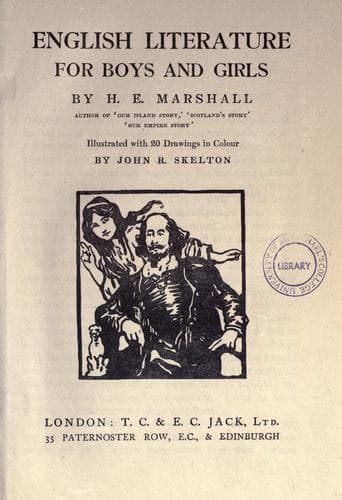
English Literature for Boys and GirlsMarshall, H. E. (Henrietta Elizabeth)
History
English Literature for Boys and Girls
Marshall, H. E. (Henrietta Elizabeth)
English literature -- History and criticism
That it is a fairyland and no real world which Spenser opens to
us is the great difference between Chaucer and him. Chaucer
gives us real men and women who love and hate, who sin and
sorrow. He is humorous, he is coarse, and he is real. Spenser
has humor too, but we seldom see him smile. There are, we may be
glad, few coarse lines in Spenser, but he is artificial. He took
the tone of his time--the tone of pretense. It was the fashion
to make-believe, yet, underneath all the make-believe, men were
still men, not wholly good nor wholly bad. But underneath the
brilliant trappings of Spenser's knights and ladies, shepherds
and shepherdesses, there seldom beats a human heart. He takes us
to dreamland, and when we lay down the book we wake up to real
life. Beauty first and last is what holds us in Spenser's poems-
-beauty of description, beauty of thought, beauty of sound. As
it has been said, "'A thing of beauty is a joy forever,' and that
is the secret of the enduring life of the Faery Queen."*
*Courthorpe, History of English Poetry.
Spenser invented for himself a new stanza of nine lines and made
it famous, so that we call it after him, the Spenserian Stanza.
It was like Chaucer's stanza of seven lines, called the Rhyme
Royal, with two lines more added.
Spenser admired Chaucer above all poets. He called him "The Well
of English undefiled,"* and after many hundred years we still
feel the truth of the description. He uses many of Chaucer's
words, which even then had grown old-fashioned and were little
used. So much is this so that a glossary written by a friend of
Spenser, in which old words were explained, was published with
the Shepherd's Calendar. But whether old or new, Spenser's power
of using words and of weaving them together was wonderful.
*Faery Queen, book VI, canto ii.
He weaves his wonderful words in such wonderful fashion that they
sound like what he describes. Is there anything more drowsy than
his description of the abode of sleep:
"And more, to lull him in his slumber soft,
A trickling stream from high rock tumbling down,
And ever drizzling rain upon the loft
Mix'd with a murmuring wind, much like the sound
Of swarming bees, did cast him in a swound,*
No other noise nor peoples' troublous cries,
As still are wont t' annoy the walled town,
Might there be heard; but careless quiet lies
Wrapt in eternal silence, far from enemies."
*Swoon.
So all through the poem we are enchanted or lulled by the glamor
of words.
Public-domain text, read in full here on John Shaqi.
Reviews
Reviews
No reviews yet
Be the first to share your thoughts on this work.
Elsewhere in the archive
Join the Discussion
Join the discussion
Sign in to leave a comment or review.
Sign InorCreate an account