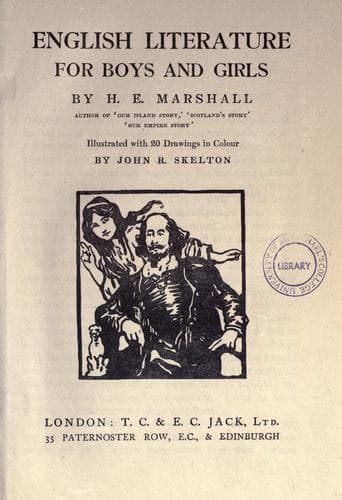
English Literature for Boys and GirlsMarshall, H. E. (Henrietta Elizabeth)
History
English Literature for Boys and Girls
Marshall, H. E. (Henrietta Elizabeth)
English literature -- History and criticism
The Faery Queen made Spenser as a poet famous, but, as we know,
it did not bring him enough to live on in England. It did not
bring him the fame he sought nor make him great among the
statesmen of the land. Among the courtiers of Queen Elizabeth he
counted for little. So he returned to Ireland a disappointed
man. It was now he wrote Colin Clout's come home again, from
which I have already given you some quotations. He published
also another book of poems and then he fell in love. He forgot
his beautiful Rosalind, who had been so hard-hearted, and gave
his love to another lady who in her turn loved him, and to whom
he was happily married. This lady, too, he made famous in his
verse. As the fashion was, he wrote to her a series of sonnets,
in one of which we learn that her name was Elizabeth. He writes
to the three Elizabeths, his mother, his Queen, and
"The third, my love, my life's last ornament,
By whom my spirit out of dust was raised."
But more famous still than the sonnets is the Epithalamion or
wedding hymn which he wrote in his lady's honor, and which ever
since has been looked on as the most glorious love-song in the
English language, so full is it of exultant, worshipful
happiness.
It was now, too, that Spenser wrote Astrophel, a sadly beautiful
dirge for the death of his friend and fellow-poet, Sir Philip
Sidney. He gave his verses as "fittest flowers to deck his
mournful hearse."
Just before his marriage Spenser finished three more books of the
Faery Queen, and the following year he took them to London to
publish them. The three books were on Friendship, on Justice,
and on Courtesy. They were received as joyfully as the first
three. The poet remained for nearly a year in London still
writing busily. Then he returned to Ireland. There he passed a
few more years, and then came the end.
Ireland, which had always been unquiet, always restless, under
the oppressive hand of England, now broke out into wild
rebellion. The maddened Irish had no love or respect for the
English poet. Kilcolman Castle was sacked and burned, and
Spenser fled with his wife and children to Cork, homeless and
wellnigh ruined. A little later Spenser himself went on to
London, hoping perhaps to better his fortunes, and there in a
Westminster inn, disappointed, ill, shattered in hopes and
health, he lay down to die.
Public-domain text, read in full here on John Shaqi.
Reviews
Reviews
No reviews yet
Be the first to share your thoughts on this work.
Elsewhere in the archive
Join the Discussion
Join the discussion
Sign in to leave a comment or review.
Sign InorCreate an account