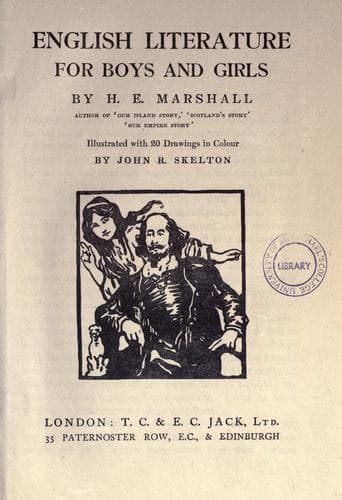
English Literature for Boys and GirlsMarshall, H. E. (Henrietta Elizabeth)
History
English Literature for Boys and Girls
Marshall, H. E. (Henrietta Elizabeth)
English literature -- History and criticism
Raleigh was not left quite lonely in the Tower. His wife and
children, whom he dearly loved, were allowed to come to live
beside him. The governor was kind to him and allowed his
renowned prisoner to use his garden. And there in a little hen-
house Raleigh amused himself by making experiments in chemistry,
and discovering among other things how to distill fresh water
from salt water. He found new friends too in the Queen and in
her young son Henry, Prince of Wales. It was a strange
friendship and a warm one that grew between the gallant boy-
prince of ten and the tried man of fifty. Prince Henry loved to
visit Raleigh in the Tower and listen to the tales of his brave
doings by sea and land in the days when he was free. Raleigh
helped Prince Henry to build a model ship, and the Prince asked
Raleigh's advice and talked over with him all his troubles. His
generous young heart grieved at the though of his friend's
misfortunes. "Who but my father would keep such a bird in such a
cage," he said with boyish indignation.
And it was for this boy friend that Raleigh began the book by
which we know him best, his History of the World. Never has such
a great work been attempted by a captive. To write the history
of even one country must mean much labor, much reading, much
thought. To write a history of the world still more. And I have
told you about Raleigh because with him begins an interest in
history beyond the bounds of our own island. Before him our
historians had only written of England.
It gives us some idea of the large courage of Raleigh's mind when
we remember that he was over fifty when he began this tremendous
piece of work for the sake of a boy he loved. Raleigh labored at
this book for seven years or more. He was allowed to have his
own books in prison. Sir Robert Cotton lent him others, and
learned friends came to talk over his book with him and help him.
And so the pile of written sheets grew. But the book was never
finished, for long before the first volume was ready the brave
young prince for whom it was written died.
To Raleigh, this was the cruelest blow fate ever dealt him, for
with the death of Prince Henry died his hope of freedom. In
spite of his long imprisonment, Raleigh had never lost hope of
one day regaining his freedom. Prince Henry just before his
death had wrung an unwilling promise from the King his father
that Raleigh should be set free. But when the Prince died the
King forgot his promise.
"O eloquent, just and mighty death!" Raleigh says in the last
lines of his book, "Whom none could advise, thou hast persuaded,
what none hath dared, thou hast done; and whom all the world hath
flattered, thou only hast cast out of the world and despised;
thou hast drawn together all the far stretching greatness, all
the pride, cruelty, and ambition of man, and covered it all over
with these two narrow words Hic Jacet.
Public-domain text, read in full here on John Shaqi.
Reviews
Reviews
No reviews yet
Be the first to share your thoughts on this work.
Elsewhere in the archive
Join the Discussion
Join the discussion
Sign in to leave a comment or review.
Sign InorCreate an account