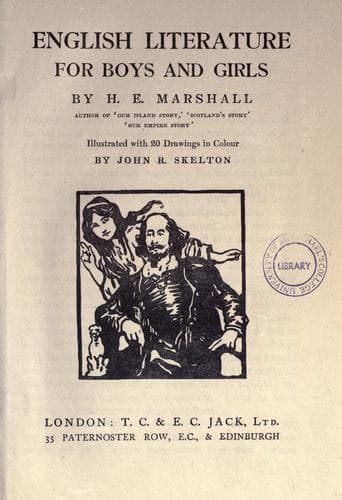
English Literature for Boys and GirlsMarshall, H. E. (Henrietta Elizabeth)
History
English Literature for Boys and Girls
Marshall, H. E. (Henrietta Elizabeth)
English literature -- History and criticism
"Lastly, whereas this book by the title it hath, calls itself,
the first part of The General History of the World, implying a
second and third volume, which I also intended and have hewn out,
besides many other discouragements, persuading my silence, it
hath pleased God to take that glorious prince out of the world,
to whom they were directed; whose unspeakable and never enough
lamented loss hath taught me to say with Job, my heart is turned
to mourning and my organ into the voice of them that weep."
Raleigh begins his great book with the Creation and brings it
down to the third Macedonian war, which ended in 168 B.C. So you
see he did not get far. But although when he began he had
intended to write much more, he never meant to bring his history
down to his own time. "I know that it will be said by many," he
writes in his preface, "that I might have been more pleasing to
the reader if I had written the story of mine own times, having
been permitted to draw water as near the well-head as another.
To this I answer that whosoever in writing a modern history,
shall follow truth too near the heels, it may haply strike out
his teeth."
Raleigh feels it much safer to write "of the elder times." But
even so, he says there may be people who will think "that in
speaking of the past I point at the present," and that under the
names of those long dead he is showing the vices of people who
are alive. "But this I cannot help though innocent," he says.
Raleigh's fears were not without ground and at one time his
history was forbidden by King James "for being too saucy in
censuring princes. He took it much to heart, for he thought he
had won his spurs and pleased the King extraordinarily," He had
hoped to please the King and win freedom again, but his hopes
were shattered.
At last, however, the door of his prison was opened. It was a
golden key that opened it. For Raleigh promised, if he were set
free, to seek once more the fabled Golden City, and this time he
swore to find it and bring home treasure untold to his master the
King.
So once more the imprisoned sea-bird was free, and gathering men
and ships he set forth on his last voyage. He set forth bearing
with him all his hopes, all his fortune. For both Raleigh and
his wife almost beggared themselves to get money to fit out the
fleet, and with him as captain sailed his young son Walter.
Public-domain text, read in full here on John Shaqi.
Reviews
Reviews
No reviews yet
Be the first to share your thoughts on this work.
Elsewhere in the archive
Join the Discussion
Join the discussion
Sign in to leave a comment or review.
Sign InorCreate an account