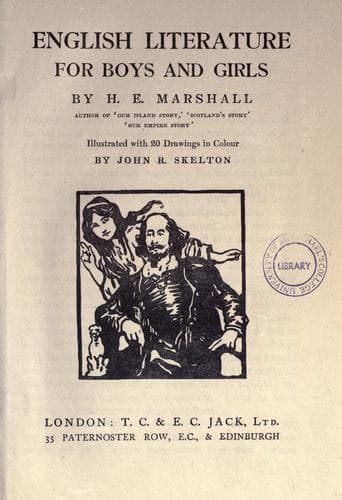
English Literature for Boys and GirlsMarshall, H. E. (Henrietta Elizabeth)
History
English Literature for Boys and Girls
Marshall, H. E. (Henrietta Elizabeth)
English literature -- History and criticism
Bacon chose the name of Baron Verulam from the name of the old
Roman city Verulamium which was afterwards called St. Albans. It
was near St. Albans that Bacon had built himself a splendid
house, laid out a beautiful garden, and planted fine trees, and
there he kept as great state as the King himself.
He had now reached his highest power. He had published his great
work called the Novum Organum or New Instrument in which he
taught men a new way of wisdom. He was the greatest judge in the
land and a peer of the realm. He had married too, but he never
had any children, and we know little of his home life.
It seemed as if at last he had all he could wish for, as if his
life would end in a blaze of glory. But instead of that in a few
short weeks after he became Viscount St. Albans, he was a
disgraced and fallen man.
He had always loved splendor and pomp, he had always spent more
than he could afford. Now he was accused of taking bribes, that
is, he was accused of taking money from people and, instead of
judging fairly, of judging in favor of those who had given him
most money. He was accused, in fact, of selling justice. That
he should sell justice is the blackest charge that can be brought
against a judge. At first Bacon could not believe that any one
would dare to attack him. But when he heard that it was true, he
sank beneath the disgrace, he made no resistance. His health
gave way. On his sick-bed he owned that he had taken presents,
yet to the end he protested that he had judged justly. He had
taken the bribes indeed, but they had made no difference to his
judgments. He had not sold justice.
He made his confession and stood to it. "My lords," he said, "it
is my act, my hand, my heart. I beseech your lordships be
merciful to a broken reed."
Bacon was condemned to pay a fine of 40,000 pounds, to be
imprisoned during the King's pleasure, never more to have
office of any kind, never to sit in Parliament, "nor come
within the verge of the Court."
"I was the justest judge that was in England these fifty years,"
said Bacon afterwards. "But it was the justest censure in
Parliament that was these two hundred years."
Bacon's punishment was not as heavy as at first sight it seems,
for the fine was forgiven him, and "the king's pleasure," made
his imprisonment in the Tower only a matter of a few days.
And now that his life was shipwrecked, though he never ceased to
long to return to his old greatness, he gave all his time to
writing and to science. He spent many peaceful hours in the
garden that he loved. "His lordship," we are told, "was a very
contemplative person, and was wont to contemplate in his
delicious walks." He was generally accompanied by one of the
gentlemen of his household "that attended him with ink and paper
ready to set down presently his thoughts."*
*J. Aubrey.
Public-domain text, read in full here on John Shaqi.
Reviews
Reviews
No reviews yet
Be the first to share your thoughts on this work.
Elsewhere in the archive
Join the Discussion
Join the discussion
Sign in to leave a comment or review.
Sign InorCreate an account