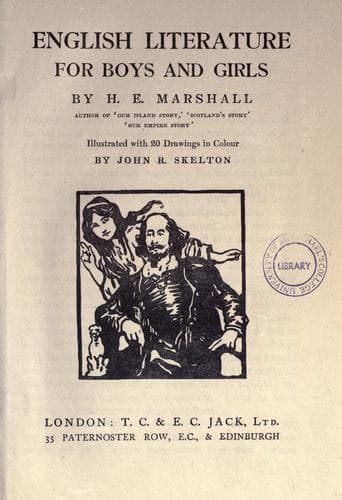
English Literature for Boys and GirlsMarshall, H. E. (Henrietta Elizabeth)
History
English Literature for Boys and Girls
Marshall, H. E. (Henrietta Elizabeth)
English literature -- History and criticism
"When I consider how my light is spent,
Ere half my days, in this dark world and wide,
And that one talent which is death to hide,
Lodg'd with me useless, though my soul more bent
To serve therewith my Maker, and present
My true account, lest He, returning, chide;
'Doth God exact day labour, light denied?'
I fondly ask: but Patience, to prevent
That murmur, soon replies, 'God doth not need
Either man's work, or His own gifts; who best
Bear His mild yoke, they serve Him best: His state
Is kingly; thousands at His bidding speed,
And post o'er land and ocean without rest;
They also serve who only stand and wait.'"
Milton meant to take up this new burden patiently, but at forty-
three, with all the vigor of life still stirring in him, he could
not meekly fold his hands to stand and wait. Indeed, his
greatest work was still to come. Blind though he was, he did not
give up his post of Latin Secretary. He still remained Chief
Secretary, and others worked under him, among them Andrew
Marvell, the poet. He still gave all his brain and learning to
the service of his country, while others supplied his lacking
eyesight. But now in the same year Fate dealt him another blow.
His wife died. Perhaps there had never been any great love or
understanding between these two, for Milton's understanding of
all women was unhappy. But now, when he had most need of a
woman's kindly help and sympathy, she went from him leaving to
his blind care three motherless girls, the eldest of whom was
only six years old.
We know little of Milton's home life during the next years. But
it cannot have been a happy one. His children ran wild. He
tried to teach them in some sort. He was dependent now on others
to read to him, and he made his daughters take their share of
this. He succeeded in teaching them to read in several
languages, but they understood not a word of what they read, so
it was no wonder that they looked upon it as a wearisome task.
They grew up with neither love for nor understanding of their
stern blind father. To them he was not the great poet whose name
should be one of the triumphs of English Literature. He was
merely a severe father and hard taskmaster.
Four years after his first wife died Milton married again. This
lady he never saw, but she was gentle and kind, and he loved her.
For fifteen months she wrought peace and order in his home, then
she too died, leaving her husband more lonely than before. He
mourned her loss in poetic words. He dreamed she came to him one
night:--
"Came vested all in white, pure as her mind;
Her face was veil'd; yet to my fancied sight
Love, sweetness, goodness, in her person shin'd
So clear, as in no face with more delight.
But O, as to embrace me she inclin'd,
I wak'd; she fled; and day brought back my night."
Public-domain text, read in full here on John Shaqi.
Reviews
Reviews
No reviews yet
Be the first to share your thoughts on this work.
Elsewhere in the archive
Join the Discussion
Join the discussion
Sign in to leave a comment or review.
Sign InorCreate an account