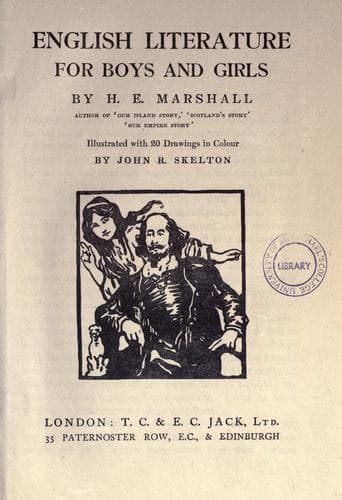
English Literature for Boys and GirlsMarshall, H. E. (Henrietta Elizabeth)
History
English Literature for Boys and Girls
Marshall, H. E. (Henrietta Elizabeth)
English literature -- History and criticism
With this sonnet (for those lines are part of the last sonnet
Milton ever wrote) it would seem as if a new period began with
Milton, his second period of poetry writing. Who knows but that
it was the sharp sorrow of his loss which sent him back to
poetry. For throughout Milton's life we can see that it was
always something outside himself which made him write poetry. He
did not sing like the birds because he must, but because he was
asked to sing by some person, or made to sing by some
circumstance.
However that may be, it was now that Milton began his greatest
work, Paradise Lost. Twenty years before the thought had come to
him that he would write a grand epic. We have scarcely spoken of
an epic since that first of all our epics, the Story of Beowulf.
And although others had written epics, Milton is to be remembered
as the writer of the great English epic. At first he thought of
taking Arthur for his hero, but as more and more he saw what a
mass of fable had gathered round Arthur, as more and more he saw
how plain a hero Arthur seemed, stripped of that fable, his mind
turned from the subject. And when, at last, after twenty years
of almost unbroken silence as a poet, he once more let his organ
voice be heard, it was not a man he spoke of, but Man. He told
the story which Caedmon a thousand years before had told of the
war in heaven, of the temptation and fall of man, and of how Adam
and Eve were driven out of the happy garden.
"Of man's first disobedience, and the fruit
Of that forbidden tree, whose mortal taste
Brought death into the world, and all our woe,
With loss of Eden, till one greater Man
Restore us, and regain the blissful seat,
Sing, Heavenly Muse."
You will remember, or if you look back to Chapter XIII you can
read again about the old poet Caedmon and what he wrote. It was
in 1655 that Junius published the so-called Caedmon Manuscript,
and Milton, who was so great a student, no doubt heard of it and
found some one to read it to him. And perhaps these poems helped
to decide him in his choice, although many years before he had
thought of writing on the subject.
Public-domain text, read in full here on John Shaqi.
Reviews
Reviews
No reviews yet
Be the first to share your thoughts on this work.
Elsewhere in the archive
Join the Discussion
Join the discussion
Sign in to leave a comment or review.
Sign InorCreate an account