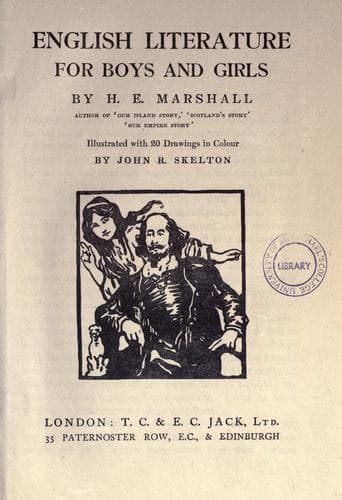
English Literature for Boys and GirlsMarshall, H. E. (Henrietta Elizabeth)
History
English Literature for Boys and Girls
Marshall, H. E. (Henrietta Elizabeth)
English literature -- History and criticism
Perhaps when you are older it may interest you to read the poems
of Milton and the poems of Caedmon together. Then you will see
how far ahead of the old poet Milton is in smooth beauty of
verse, how far behind him sometimes in tender knowledge of man
and woman. But I do not think you can hope to read Paradise Lost
with true pleasure yet a while. It is a long poem in blank
verse, much of it will seem dull to you, and you will find it
hard to be interested in Adam and Eve. For Milton set himself a
task of enormous difficulty when he tried to interest common men
and women in people who were without sin, who knew not good nor
evil. Yet if conceit, if self-assurance, if the want of the
larger charity which helps us to understand another's faults, are
sins, then Adam sinned long before he left Milton's Paradise. In
fact, Adam is often a bore, and at times he proves himself no
gentleman in the highest and best meaning of the word.
But in spite of Adam, in spite of everything that can be said
against it, Paradise Lost remains a splendid poem. Never,
perhaps, has the English language been used more nobly, never has
blank verse taken on such stately measure. Milton does not make
pictures for us, like some poets, like Spenser, for instance; he
sings to us. He sings to us, not like the gay minstrel with his
lute, but in stately measured tones, which remind us most of
solemn organ chords. His voice comes to us, too, out of a poet's
country through which, if we would find our way, we must put our
hand in his and let him guide us while he sings. And only when
we come to love "the best words in the best order" can we truly
enjoy Milton's Paradise Lost.
Milton fails at times to interest us in Adam, but he does
interest us in the Bad Angel Satan, and it has been said over and
over again that Satan is his true hero. And with such a man as
Milton this was hardly to be wondered at. All his life had been
a cry for liberty--liberty even when it bordered on rebellion.
And so he could not fail to make his arch rebel grand, and even
in his last degradation we somehow pity him, while feeling that
he is almost too high for pity. Listen to Satan's cry of sorrow
and defiance when he finds himself cast out from Heaven:--
Public-domain text, read in full here on John Shaqi.
Reviews
Reviews
No reviews yet
Be the first to share your thoughts on this work.
Elsewhere in the archive
Join the Discussion
Join the discussion
Sign in to leave a comment or review.
Sign InorCreate an account