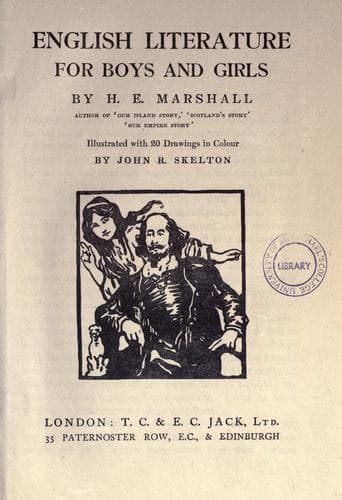
English Literature for Boys and GirlsMarshall, H. E. (Henrietta Elizabeth)
History
English Literature for Boys and Girls
Marshall, H. E. (Henrietta Elizabeth)
English literature -- History and criticism
"'Is this the region, this the soil, the clime,'
Said then the lost Archangel, 'this the seat
That we must change for heaven?--this mournful gloom
For that celestial light? Be it so, since he
Who now is sovran can dispose and bid
What shall be right; farthest from his is best,
Whom reason hath equalled, force hath made supreme
Above his equals. Farewell, happy fields,
Where joy for ever dwells! Hail, horrors! hail,
Infernal world! and thou, profoundest Hell
Receive thy new possessor--one who brings
A mind not to be changed by place or time,
The mind is its own place, and in itself
Can make a Heaven of Hell, a Hell of Heaven.
What matter where, if I be still the same,
And what I should be, all but less than he
Whom thunder hath made greater? Here at least
We shall be free the Almighty hath not built
Here for his envy, will not drive us hence;
Here we may reign secure; and, in my choice,
To reign is worth ambition, though in Hell:
Better to reign in Hell than serve in Heaven.'"
Then in contrast to this outburst of regal defiance, read the
last beautiful lines of the poem and see in what softened mood of
submission Milton pictures our first parents as they leave the
Happy Garden:--
"In either hand the hastening Angel caught
Our lingering parents, and to the eastern gate
Led them direct, and down the cliff as fast
To the subjected plain--then disappeared.
They, looking back, all the eastern side beheld
Of Paradise, so late their happy seat,
Waved over by that flaming brand; the gate
With dreadful faces thronged and fiery arms.
Some natural tears they dropped, but wiped them soon;
The world was all before them, where to choose
Their place of rest, and Providence their guide.
They, hand in hand, with wandering steps and slow,
Through Eden took their solitary way."
Milton worked slowly at this grand poem. Being blind he had now
to depend on others to write out what poetry he made in his own
mind, so it was written "in a parcel of ten, twenty, or thirty
verses at a time by whatever hand came next." We are told that
when he was dictating sometimes he sat leaning back sideways in
an easy-chair, with his leg flung over the arm. Sometimes he
dictated from his bed, and if in the middle of the night lines
came to him, whatever time it was he would ring for one of his
daughters to write them down for him, lest the thought should be
lost ere morning.
We are told, too, that he wrote very little in summer. For he
said himself that it was in winter and spring that his poetic
fancy seemed to come best to him, and that what he wrote at other
times did not please him. "So that in all the years he was about
this poem, he may be said to have spent but half his time
therein."*
*Philips.
Public-domain text, read in full here on John Shaqi.
Reviews
Reviews
No reviews yet
Be the first to share your thoughts on this work.
Elsewhere in the archive
Join the Discussion
Join the discussion
Sign in to leave a comment or review.
Sign InorCreate an account