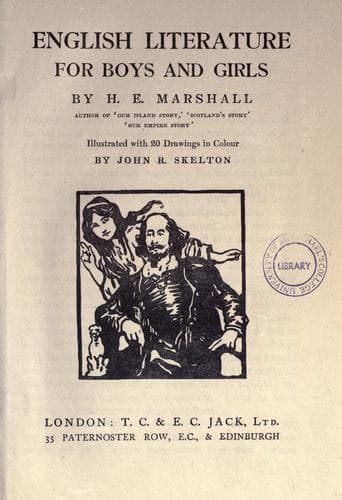
English Literature for Boys and GirlsMarshall, H. E. (Henrietta Elizabeth)
History
English Literature for Boys and Girls
Marshall, H. E. (Henrietta Elizabeth)
English literature -- History and criticism
But now, while Milton's mind was full of splendid images, while
in spite of the discomfort and lonliness of his misruled home, he
was adding line to line of splendid sounding English, great
changes came over the land.
Oliver Cromwell died. To him succeeded his son Richard. But his
weak hands could not hold the scepter. He could not bind
together a rebel people as great Oliver had done. In a few
months he gave up the task, and little more than a year later the
people who had wept at the death of the great Protector, were
madly rejoicing at the return of a despot.
With a Stuart king upon the throne, there was no safety for the
rebel poet who had used all the power of his wit and learning
against the Royal cause. Pity for his blindness might not save
him. So listening to the warnings of his friends, he fled into
hiding somewhere in the city of London, "a place of retirement
and abscondence."
But after a time the danger passed, and Milton crept forth from
his hiding-place. It was perhaps pity for his blind
helplessness, perhaps contempt for his powerlessness, that saved
him, who can tell? His books were burned by the common hangman,
and he found himself in prison for a short time, but he was soon
released. While others were dying for their cause, the blind
poet whose trumpet call had been Liberty! Liberty! was
contemptuously allowed to live.
Now indeed had Milton fallen on dark and evil days. He had
escaped with his life and was free. But all that he had worked
for during the past twenty years he saw shattered as at one blow.
He saw his friends suffering imprisonment and death, himself
forsaken and beggared. He found no sympathy at home. His
daughters, who had not loved their father in his days of wealth
and ease, loved him still less in poverty. They sold his books,
cheated him with the housekeeping money, and in every way added
to his unhappiness. At length, as a way out of the misery and
confusion of his home, Milton married for the third time.
The new wife was a placid, kindly woman. She managed the house,
managed too the wild, unruly girls as no one had managed them
before. She saw the folly of keeping them, wholly untamed and
half-educated as they were, at home, and persuaded her husband to
let them learn something by which they might earn a living. So
they went out into the world "to learn some curious and ingenious
sorts of manufacture, that are proper for women to learn,
particularly embroideries in gold and silver."
Public-domain text, read in full here on John Shaqi.
Reviews
Reviews
No reviews yet
Be the first to share your thoughts on this work.
Elsewhere in the archive
Join the Discussion
Join the discussion
Sign in to leave a comment or review.
Sign InorCreate an account