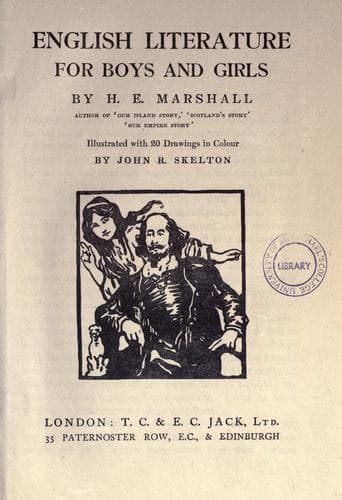
English Literature for Boys and GirlsMarshall, H. E. (Henrietta Elizabeth)
History
English Literature for Boys and Girls
Marshall, H. E. (Henrietta Elizabeth)
English literature -- History and criticism
Thus for the last few years of his life Milton was surrounded by
peace and content such as he had never before known. All through
life he had never had any one to love him deeply except his
father and his mother, whose love for him was perhaps not all
wise. Those who had loved him in part had feared him too, and
the fear outdid the love. But now in the evening of his days, if
no perfect love came to him, he found at least kindly
understanding. His wife admired him and cared for him. She had
a fair face and pretty voice, and it is pleasant to picture the
gray-haired poet sitting at his organ playing while his wife
sings. He cannot see the sun gleam and play in her golden hair,
or the quick color come and go in her fair face, but at least he
can take joy in the sound of her sweet fresh voice.
It was soon after this third marriage that Paradise Lost was
finished and published. And even in those wild Restoration days,
when laughter and pleasure alone were sought, men acknowledged
the beauty and grandeur of this grave poem. "This man cuts us
all out, and the ancients too," said Dryden, another and younger
poet.
People now came to visit the author of Paradise Lost, as before
they had come to visit great Cromwell's secretary. We have a
pleasant picture of him sitting in his garden at the door of his
house on sunny days to enjoy the fresh air, for of the many
houses in which Milton lived not one was without a garden.
There, even when the sun did not shine, wrapt in a great coat of
coarse gray cloth, he received his visitors. Or when the weather
was colder he sat in an upstairs room hung with rusty green. He
wore no sword, as it was the fashion in those days to do, and his
clothes were black. His long, light gray hair fell in waves
round his pale but not colorless face, and the sad gray eyes with
which he seemed to look upon his visitors were still clear and
beautiful.
Life had now come for Milton to a peaceful evening time, but his
work was not yet finished. He had two great poems still to
write.
One was Paradise Regained. In this he shows how man's lost
happiness was found again in Christ. Here is a second
temptation, the temptation in the wilderness, but this time Satan
is defeated, Christ is victorious.
The second poem was Samson Agonistes, which tells the tragic
story of Samson in his blindness. And no one reading it can fail
to see that it is the story too of Milton in his blindness. It
is Milton himself who speaks when he makes Samson exclaim:--
Public-domain text, read in full here on John Shaqi.
Reviews
Reviews
No reviews yet
Be the first to share your thoughts on this work.
Elsewhere in the archive
Join the Discussion
Join the discussion
Sign in to leave a comment or review.
Sign InorCreate an account