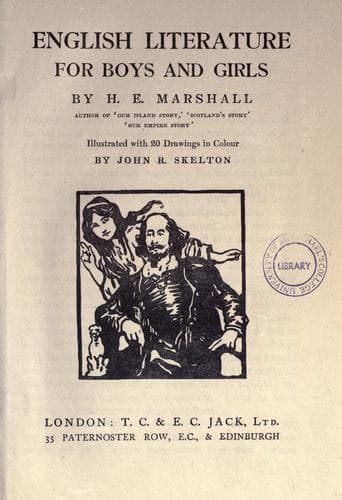
English Literature for Boys and GirlsMarshall, H. E. (Henrietta Elizabeth)
History
English Literature for Boys and Girls
Marshall, H. E. (Henrietta Elizabeth)
English literature -- History and criticism
"O loss of sight, of thee I most complain!
Blind among enemies: O worse than chains,
Dungeon, or beggary, or decrepit age!
Light, the prime work of God, to me is extinct,
And all her various objects of delight
Annulled, which might in part my grief have eased.
Inferior to the vilest now become
Of man or worm: the vilest here excel me,
They creep, yet see; I, dark in light, exposed
To daily fraud, contempt, abuse, and wrong,
Within doors, or without, still as a fool,
In power of others, never in my own;--
O dark, dark, dark, amid the blaze of noon,
Irrecoverably dark, total eclipse
Without all hope of day!"
This was Milton's last poem. He lived still four years longer
and still wrote. But his singing days were over, and what he now
wrote was in prose. His life's work was done, and one dark
November evening in 1674 he peacefully died.
"Thy soul was like a Star, and dwelt apart:
Thou hadst a voice whose sound was like the sea:
Pure as the naked heavens, majestic, free,
So didst thou travel on life's common way."*
*Wordsworth.
Chapter LIX BUNYAN--"THE PILGRIM'S PROGRESS"
THE second great Puritan writer of England was John Bunyan. He
was born in 1628, more than twenty years after Milton. His
father was a tinker. A tinker! The word makes us think of
ragged, weather-worn men and women who wander about the
countryside. They carry bundles of old umbrellas, and sometimes
a battered kettle or two. They live, who knows how? they sleep,
who knows where? Sometimes in our walks we come across a charred
round patch upon the grass in some quiet nook by the roadside,
and we know the tinkers have been there, and can imagine all
sorts of stories about them. Or sometimes, better still, we find
them really there by the roadside boiling a mysterious three-
legged black kettle over a fire of sticks.
But John Bunyan's father was not this kind of tinker. He did not
wander about the countryside, but lived at the little village of
Elstow, about a mile from the town of Bedford, as his father had
before him. He was a poor and honest workman who mended his
neighbors' kettles and pans, and did his best to keep his family
in decent comfort.
One thing which shows this is that little John was sent to
school. In those days learning, even learning to read and write,
was not the just due of every one. It was only for the well-to-
do. "But yet," says Bunyan himself, "notwithstanding the
meanness and inconsiderableness of my parents, it pleased God to
put it into their hearts to put me to school, to learn me both to
read and write."
Public-domain text, read in full here on John Shaqi.
Reviews
Reviews
No reviews yet
Be the first to share your thoughts on this work.
Elsewhere in the archive
Join the Discussion
Join the discussion
Sign in to leave a comment or review.
Sign InorCreate an account